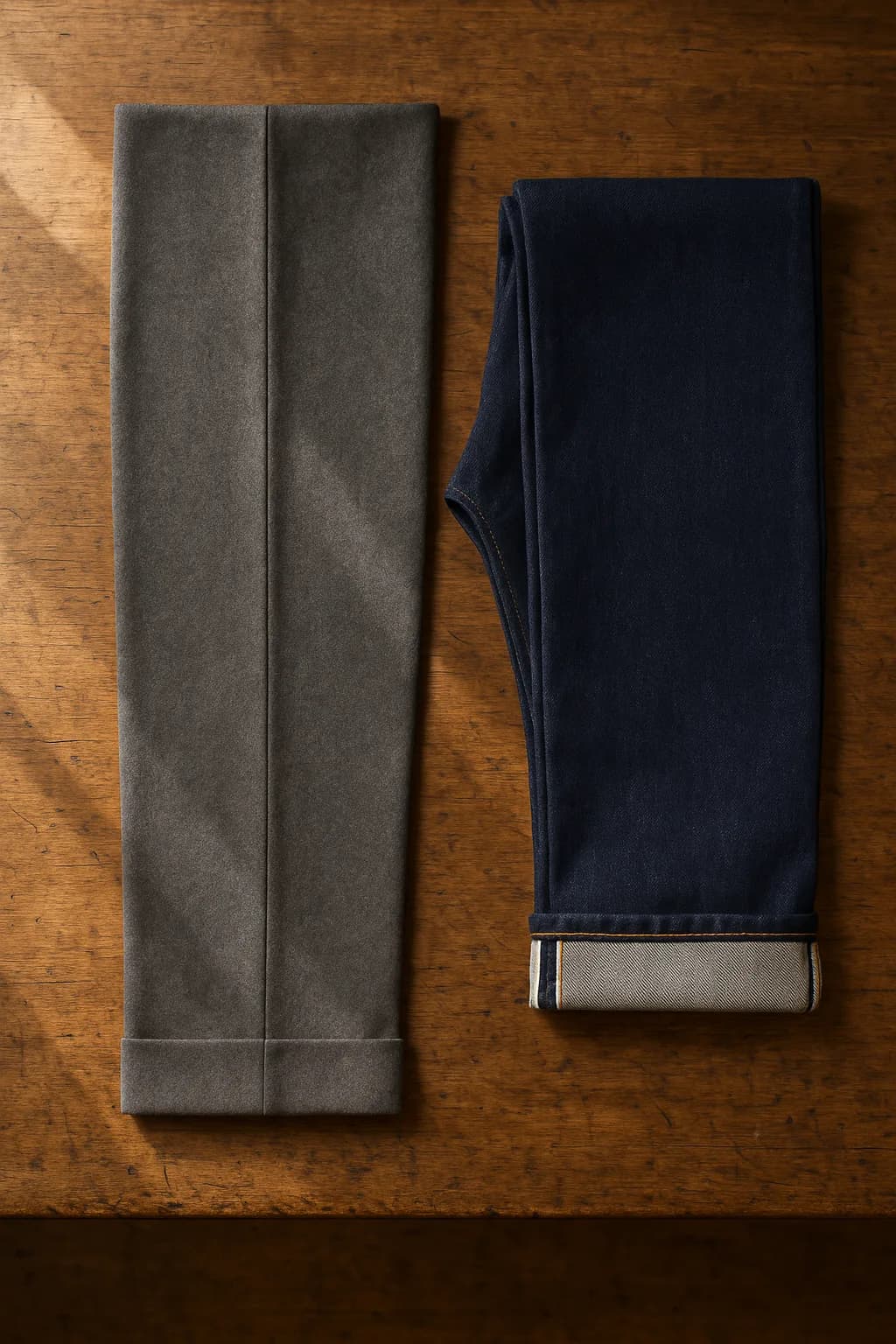
Trousers
Rise, seat, leg and break.
A high conventional rise improves proportion beneath a jacket but looks stuffy alone. Without a jacket, chinos sit better slightly lower on the hip.
Without a jacket, a high rise leaves too much cloth around the lap.
Read all 82 rulesClose the list
With well fitted trousers, any front can look right. If a style looks wrong, suspect the fit before the style.
In trousers, get the rise, seat and thighs right in the shop. Waist, leg shape and length can be altered, best by small amounts.
Most of the rest is within a tailor's reach.
Back balance is the hardest part of trouser fit. A back that is too long or too short ripples beneath the seat or down the thigh.
A slightly higher rise and a clean line straight from waistband to hem make trousers look well cut.
When trousers are fitted, wear the shoes and set the waistband where it will sit in daily life. Otherwise every change is a guess.
A different shoe or waist height changes how the hem falls.
A slimmer thigh lets the leg taper without widening the hips. A high natural rise on a slim leg looks sharp with subtle pleats breaking up the lap.
Tan worsted flannel trousers, the wool counterpart of khaki cotton, suit navy and dark brown blazers and make a versatile separate.
Judge trouser fit in a three-way mirror or with a friend's eye, because craning to look in an ordinary mirror changes how the cloth hangs.
Light to mid-grey wool trousers earn their place. Navy and dark brown jackets contrast with them; grey jackets add less.
Full trousers hang cleanly but look shapeless, and slim ones cling. Well-cut trousers flatter, with a long, sleek line and no rippling.
Trousers cut too tight restrict movement, so comfort in motion sets a limit on how slim they go.
Finer-wale corduroy can be worn into summer, while chunky wide-wale cord is a cold-weather cloth.
Trouser fit is about showing the shape of real legs with a considered hem break. Wide trousers bend this rule by playing with proportion on purpose.
Choose a silhouette by your own proportions. A shorter torso, for example, suits a higher rise.
Plain hems look sleeker and cuffs more traditional. Pleated trousers call for cuffs; flat fronts take either. When unsure, cuff, since cuffs can be removed but not added.
Formal trousers take a high rise, shallow pleats and a waistband without loops. Casual ones can sit lower, with plain fronts and loops.
Side tabs and suspenders suit a high rise better than belts.
A trouser leg that is too slim looks wrong, and one that is too wide leans classic. The right width depends on the waist size.
Chinos are easier in darker khaki or olive than in mid-tone khaki. A subtle twill weave in navy beats plain weave or drill.
Flannel trousers work across three seasons. Worsted flannel is tougher, woollen flannel handsomer. Good shades are medium grey, pale grey and fawn.
Dark trousers are hard to wear with tailored jackets, which are usually dark, so lighter trousers tend to work more easily.
The two darks leave no contrast between jacket and trousers.
For warm weather, linen in tan, cream or tobacco brown works, as does open-weave tropical wool. A very scratchy tropical wool wants a lining.
For cold weather, tweed, tan cavalry twill, moleskin and corduroy suit trousers. The best moleskin is brown and corduroy looks best in wheat or dark brown.
Navy trousers can work with tailoring, especially with grey or cream jackets, though grey and tan remain the most useful trouser colours.
Olive chinos coordinate well with brown or grey jackets and read as casual, because the eye links the colour to army trousers.
Cream trousers suit warm-toned clothes, while sand suits cool-toned ones. Cream also works tone-on-tone with warm colours as well as in classic brown and navy pairings.
Stone or cream trousers go with nearly anything above them. Thicker cotton stops pale trousers from being see-through.
Pale cotton can be sheer in a summer weight.
Trousers with strong ribbing and a mottled look appear sportier and suit earthier colours.
Most outfits draw the eye to the upper half, and trousers recede. Pattern is therefore easier to carry on a jacket than on trousers.
Cargo trousers belong with workwear and Americana: chambray, flannel, denim jackets and boots. Polos and preppy clothes sit badly beside them.
Military-style trousers such as olive fatigues and plain chinos handle hot days better than heavy raw denim.
They were designed for hot climates.
Five-pocket corduroy sits mid-way in formality: dressier than jeans, easier than tailored trousers. Well cut, it suits a tweed sport coat; tan is the most versatile shade.
Shorts look best with a looser leg and an inseam of about five inches. A trim knee-length short looks like slim trousers cut down.
Tailored trousers worn with western or rugged pieces should be in rustic cloth such as cavalry twill, cord or whipcord, not slick worsted or flannel.
The trousers chosen first influence the shoes and everything above them, so a good pair makes the outfit.
Untreated heavy-cotton trousers can fit stiff at first. A cold wash softens them and corrects the silhouette.
Keep cuffs in proportion to height. A shorter man usually suits smaller ones.
A deep cuff breaks the vertical line more on a short frame.
A fuller trouser wants at least a little break at the hem, while a narrower one looks right with less or none.
The break balances the width of the leg.
A wide leg opening makes the feet look small, and a narrow one makes them look large. Judge the opening against the shoe.
The foot and trouser read together.
Pleats break up a flat expanse of cloth across the front and add room at the thigh, which helps men who need a fuller leg.
Trousers that gather in a pool at the shoe are too long. The leg hangs vertically with a small break at most, or none on a shorter leg.
A horizontal pool of cloth cuts the line of the leg.
One or two fairly shallow pleats help shape the silhouette. More than two tips into excess.
Button-closed cuffs can be undone to shake out dirt, and selvedge-lined pockets are a quiet mark of care. Both are seen only on close inspection.
Trousers tight at the hips make the side pockets gape. Seams that run along the pocket opening ease the problem.
A French fly, or waist stay, is a hidden tab buttoned inside the waistband. It eases strain on the zip and lets the fly lie flat.
Cavalry twill has a doubled twill weave and is smooth, hardwearing and crease resistant. Covert and whipcord have single lines and read more rustic and casual.
Horseshoe folds under the seat, with ripples running behind the legs, show a back rise that is too long.
The waistband carries the trousers, so the back rise decides how the cloth falls.
Trouser waistbands sit best about one and a half to two centimetres above the navel, with a seat that leaves slack for sitting.
Seen from the side, trousers should show clean lines. Denser cloth drapes better, and very soft cloth makes poor trousers.
Trousers have little inside structure, yet small choices in cutting the legs and waist still change the silhouette.
Trousers are easier to fit than jackets because there is little inside structure. Once a pattern is right, repeat orders are simple.
Machines suit the long outseams and inseams of trousers. Buttonholes, bar tacks and the waistband attachment are better done by hand.
A small percentage of stretch fibre in chinos stops a slim leg from bagging at the knee.
Soft, heavy cloth can be cut fuller without looking sloppy, because it hangs and stacks rather than standing out.
A higher rise with pleats works best when it does not billow. Slimming the leg a little keeps it from looking dated.
Pleated high-rise trousers look vintage if too full.
A button fly avoids the bunching across the lap that a zip fly can produce when seated.
Trousers with no back pockets give a cleaner line and are easier to alter, since cut pockets limit how far the seat can change.
A slanted hip pocket is easier to reach into than one set straight at the seam. Letting the side seam follow the opening keeps the tidy look.
A hem cut longer at the back covers the back of the shoe and gives a cleaner leg line.
High-rise trousers do better with pleats, which break up the wide stretch of cloth. Forward pleats are English and hold a crease; reverse pleats are Italian, more casual.
A self-belted trouser with a broad belt looks more refined than drawstring or Gurkha styles, and cinches precisely so the waist never pinches.
Ready-made trousers can crumple below the seat and ripple down the rear of the leg when the wearer stands hips forward with locked knees.
Back fit depends heavily on posture.
Woollen flannel is soft, lofty and warm, with a cloudy surface. Worsted flannel is sturdier and cooler, with twill showing, so it suits mild seasons.
Worsted fibres are combed parallel before spinning; woollen ones are not.
In a changing season, trousers can be heavier than the jacket, since they hang well without adding much warmth.
Tweed trousers usually need a full lining because the cloth is rough. Few tweeds are firm enough to cut as trousers; most are limp and springy.
Hard-twisted twills such as covert, whipcord and cavalry twill hang heavily and hold their shape. Flannel can sag and need pressing again.
Tight yarn twist resists sagging; flannel loosens with wear.
Shaped knees, pleated pocket boxes and drawstring hems give a trouser leg a more interesting outline than a plain slim-straight cut.
White corduroy can be fairly neutral on dry autumn days, not only in summer, because the texture makes the pale colour feel seasonal.
A tailor can take excess cloth from beneath the seat by shortening the back rise and lowering the crotch point at the inner seam. Otherwise it pulls tight.
Ready-to-wear trousers often have a long back rise, as makers err loose. Cheaper pairs may lack spare cloth inside to release the crotch.
Trousers that are too tight cause discomfort and are harder to fix.
A clean back line matters most with tailored suits and sport coats. Casual trousers can carry a little rumpling.
Spongy, loosely made cloth bags quickly at the knee in trousers. Cut it fuller, or choose denser machine-made cloth over hand-loomed.
Crisp, dark blue trousers show warm-versus-cool contrast more than faded, washed denim does.
Corduroy improves with age; crushed, patchy ribs look good rumpled. Slick worsted looks best fresh and pressed.
Casual chinos are usually finished without cuffs. Heavier cold-season trousers often look better cuffed, most of all over boots.
Cuffs add weight and a sporting, outdoor feel.
A low rise can look clean and lengthen the torso, but it slips, untucks the shirt and leaves a gap between the jacket button and the belt.
Braces are usually kinder than a belt and keep the shirt tucked. They also help when the stomach would push trousers down.
Taking a trouser waist in by more than about two inches pulls the side seams too far back.
Casual chinos have visible stitching on the side seams, cheaper cloth, a lower rise and often a wash. They suit casual shirts, not smooth poplin dress shirts.
Dress chinos have hidden seam stitching, a higher rise, better cloth and an unhemmed leg. They suit a sport coat and tie, not a worn-out tee.
Leave cuffs off very formal trousers. Cuffs began as mudguards, so they are casual, and they clash with the braid down the leg.
With a texture-heavy top half, choose trousers with visual weight, such as denim, moleskin or corduroy, rather than light office chinos.