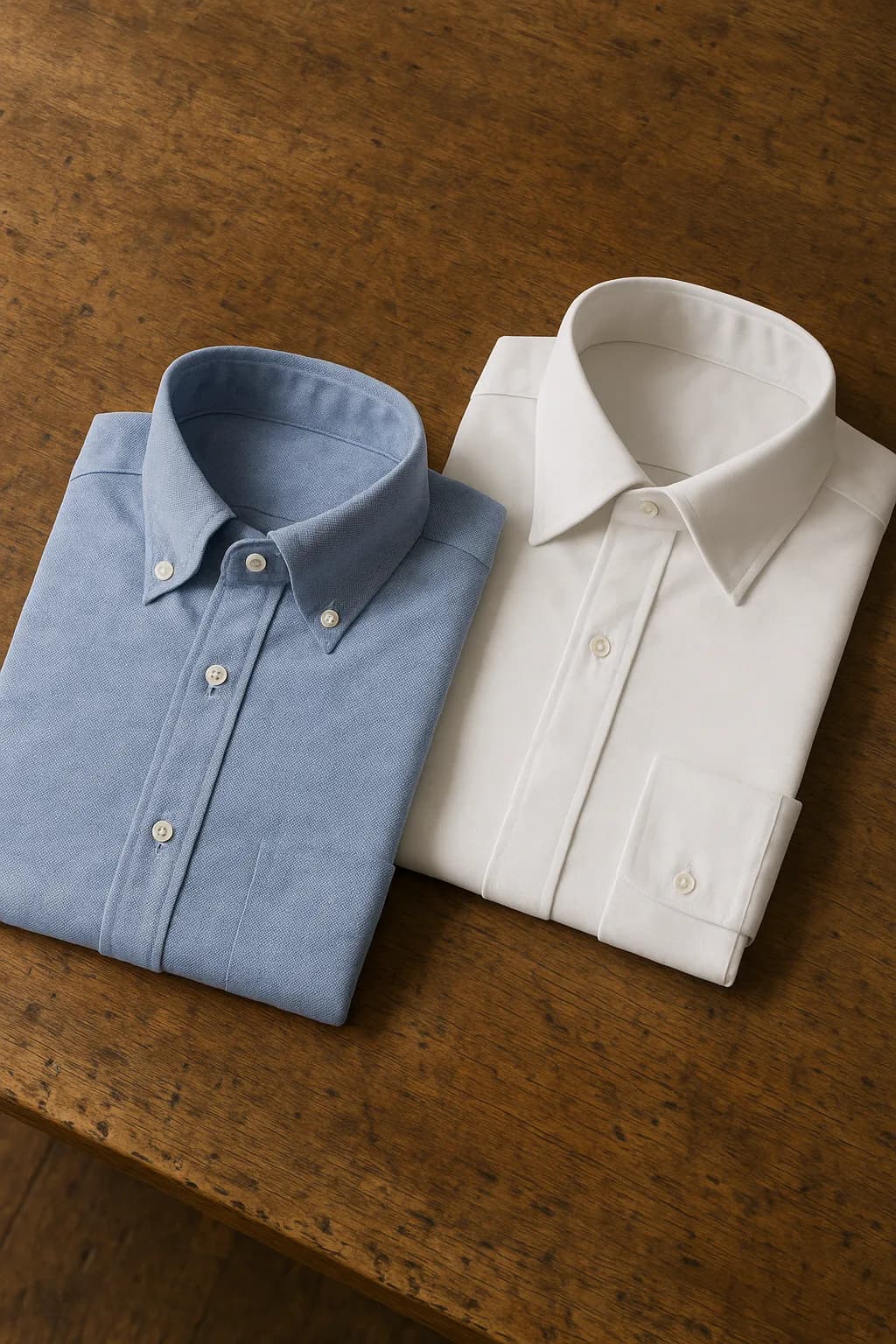
The shirt
The collar frames the face; the cuff finishes the sleeve.
Shirt collar points are long enough to tuck behind the jacket lapels, so the line under the chin stays unbroken.
A classic shirt body is moderately trim, neither billowy nor tight, and the armhole sits fairly high.
Read all 74 rulesClose the list
Judge a shirt seated and with arms moving, not only standing at a mirror. Very slim shirts often pull across the stomach when sitting.
Fit has to survive a full day.
Collar size is read against the head. A small collar makes a large head look larger, and a large collar makes a small head look smaller.
A longer neck also suits a taller collar band.
A polo fits slightly trim through the body, sleeves ending near mid-biceps. If the hem falls below the hips, tuck it in.
Length decides whether it is worn out or in.
An armhole sits high enough when both arms can lift without pulling the shirt out of the trousers.
An undershirt fits close, feels soft and is long enough to stay tucked. Many shrink short in the wash, and a normal size can balloon.
A popover shirt can stand alone. A dressier one tucks in; a casual one is worn out over jeans.
It is interesting enough without a layer.
A coloured open-weave cloth shows less through than white, so choose colour when you want airy cloth that does not turn see-through.
In a fuller, slouchier shirt, collar points run a little longer and pockets a little larger so the parts keep their proportion to the roomy body.
A tee is best cut trim and layered beneath a jacket, not worn by itself.
Tees generally look best when they are not tightly fitted. A clingy jersey shows the body instead of giving the outfit a shape.
Flannels in a coarse, thick, heavy cloth get worn. Thin, limp ones rarely do.
A shorter flannel shirt sits neatly under a cropped jacket.
A dressier plaid flannel pairs with chunky Aran sweaters, heavy tweed and waxed cotton. A sturdier one belongs with workwear and raw denim.
A polo wears better with a deeper placket, an interesting collar and long sleeves than as a plain piqué of the mall kind.
A polo under a casual sport coat needs a collar that stands up unaided, from a single-piece collar or a band-style build.
A limp collar collapses beneath the lapels.
Cloth with slight variation in colour or weave, such as end-on-end, twill or fine chambray, is more interesting than flat poplin and still suits work.
The variation is small enough that only the wearer notices.
A Western shirt collection starts with basic blue denim. To avoid head-to-toe denim, vary the colour of the jeans.
A chamois shirt is too bulky to tuck, so wear it as a light jacket over a tee or turtleneck.
A heavier tee cloth with a tight, reinforced collar keeps its shape through many wears.
Unbuttoned, a sleeve reaches the web between thumb and forefinger. Buttoned, it sits a little below the wrist, with extra length so it does not ride up.
Test with arms extended.
Buttoned at the neck, a collar leaves room for one finger. Check after a few washes, since new shirts are cut a little large for shrinkage.
A tight neck gets tighter.
To judge how breathable a cloth is, hold it against the light. More light through it means better airflow.
Yarn-dyed cloth colours the yarn before weaving, so mixed coloured and plain yarns give a chambray effect with more depth than piece-dyed cloth.
A medium-spread collar with balanced front and back height looks sedate and suits a coat and tie.
A single-button cuff set back from the edge leaves room for a watch, and a gently rounded cuff looks clean.
A one-piece collar holds up even when worn open, unlike many that collapse beneath the lapels.
Its interlining runs unbroken from the points into the body.
A knit polo with longer collar points and a fused collar stays upright and does not collapse under a jacket.
A button-down collar with an unlined interior is softer than one with a floating interlining, and looks a little rumpled by design.
Longer collar points on a button-down give a fuller, more relaxed roll. Short, skimpy points lose that curve.
A true oxford keeps slight irregularities and slubs, with visible colour variation from its blue and white yarns. Smooth, luxurious versions miss its character.
A tailor can fine-tune the soft roll of a button-down collar by moving the collar-point buttons a tiny fraction.
If a man's shoulders slope unevenly, a shirt not cut for it shows pull lines from collarbone to underarm.
Very few men have shoulders that match.
The waist point of a shirt sits at the natural waist. Higher or lower, it makes creases beneath the ribs and lets the body balloon.
A blurry, soft fade on a denim shirt reads closer to a dress shirt. A streaky fade has a cowboy feel.
A good tee is trim and only just long enough, with short sleeves. A tee that rides above the belt shows skin and looks too short.
A shorter, trimmer tee body with slightly short sleeves and a high, tight neckline gives a vintage silhouette.
A heavier, stouter cotton makes a white tee less see-through and better at holding shape, but a very heavy one is too hot for summer.
A curved, mid-length hem lands in an awkward zone: too long to leave out, too short to tuck. A short, square hem works untucked.
A shirt with a short front tail and a long back tail suits neither tucking in nor wearing out.
Long shirttails help a shirt stay tucked under a jacket.
A long-sleeve polo shows the proper quarter inch of cuff under a jacket, and a collar band holds the collar up better than a floppy one.
Button-down collar points are fastened down so they do not slip under the lapels, unlike unsupported spread collars worn without a tie.
A long collar point helps a collar support a tie properly.
The extra length keeps the collar standing against the knot.
A Western shirt with a higher armhole and long tails stays tucked and pairs better with a tailored jacket.
A rugged shirt shows two chest pockets, plain pockets, flannel or a western cut: all give a utilitarian look.
A work-style shirt with slightly longer collar points lies flat under a jacket, and pearl buttons give it a dressier touch.
A holiday collar is cut in one piece with no separate band and is worn open for a relaxed look.
Chamois cotton is soft, plush and durable, and a washed one fades into a charming layering piece.
A silky shirt drapes and sways, and works with casual cotton suits, denim and leather jackets.
Medium collar points work with a tie and without. Fuller points frame a tie better but look strained when the collar is worn open.
Choose by how often a tie is worn.
A fused collar looks crisper, especially after washing, which suits business. An unfused one looks softer but wrinkles and can shrink unevenly.
Pick by the look wanted.
A few creases by evening are fine. Some cloths, oxford above all, hardly need ironing at all.
A spread collar suits a long face, and longer, narrower collar points suit a rounder face.
The collar frames the face, so its shape should complement it.
Extremely slim cuts exaggerate the build of heavier and thinner men alike. Try the regular slim before the extra slim.
A small amount of t-shirt hem shows below a jacket at most. A very long shirt hem looks less relaxed.
Linen blended with another fibre wrinkles less and often costs less than pure linen.
A bold vintage-style shirt pairs best with relaxed suits in linen or cotton, light wool jackets and high-waisted trousers.
Mid-blue chambray is hard to wear with jeans. A heavily washed, paler one pairs easily with denim and works across seasons.
A real denim shirt holds up under a hard-finished tweed better than most shirtings, and looks relaxed with tan chinos.
A loose, boxy tee with long sleeves and dropped shoulders belongs with experimental, minimal wardrobes rather than traditional ones.
A collar frames the face and finishes the upper edge of the body, so a collared shirt usually looks better than a tee once the outerwear comes off.
A polo's stretchy knit forgives the body more than a woven shirt and needs little pressing.
A soft, unstarched polo collar frames the face more kindly than a crew neck, and skips the stiffness of a dress collar.
A knitted polo with a floppy collar looks presentable without ironing and suits casual tailoring with slip-on shoes.
For a collar worn only under a jacket, a cutaway suits. A soft button-down is more flexible when the shirt may be worn alone.
A subdued Western-style shirt can sit with tweed jackets and casual suits as well as with jeans.
Plain styling reads as a casual shirt rather than costume.
In extreme heat, a light shirt worn open over a tee adds layering interest without heavy outerwear.
A sleeveless undershirt lets an open-necked shirt show a flattering V instead of exposed skin.
With a tailored outfit the undershirt neckline stays hidden. A rugged shirt can tolerate a visible layer underneath.
Traditional neckwear rarely suits a non-traditional shirt colour. On a tonal shirt, a buttoned collar stands better than a spread one.
Under a tailored jacket worn casually, a knit polo or tee can replace the pressed dress shirt.
Treated non-iron shirts often have a slightly artificial shine and feel clammy, and the finish eventually washes out. A complete absence of creases gives them away.