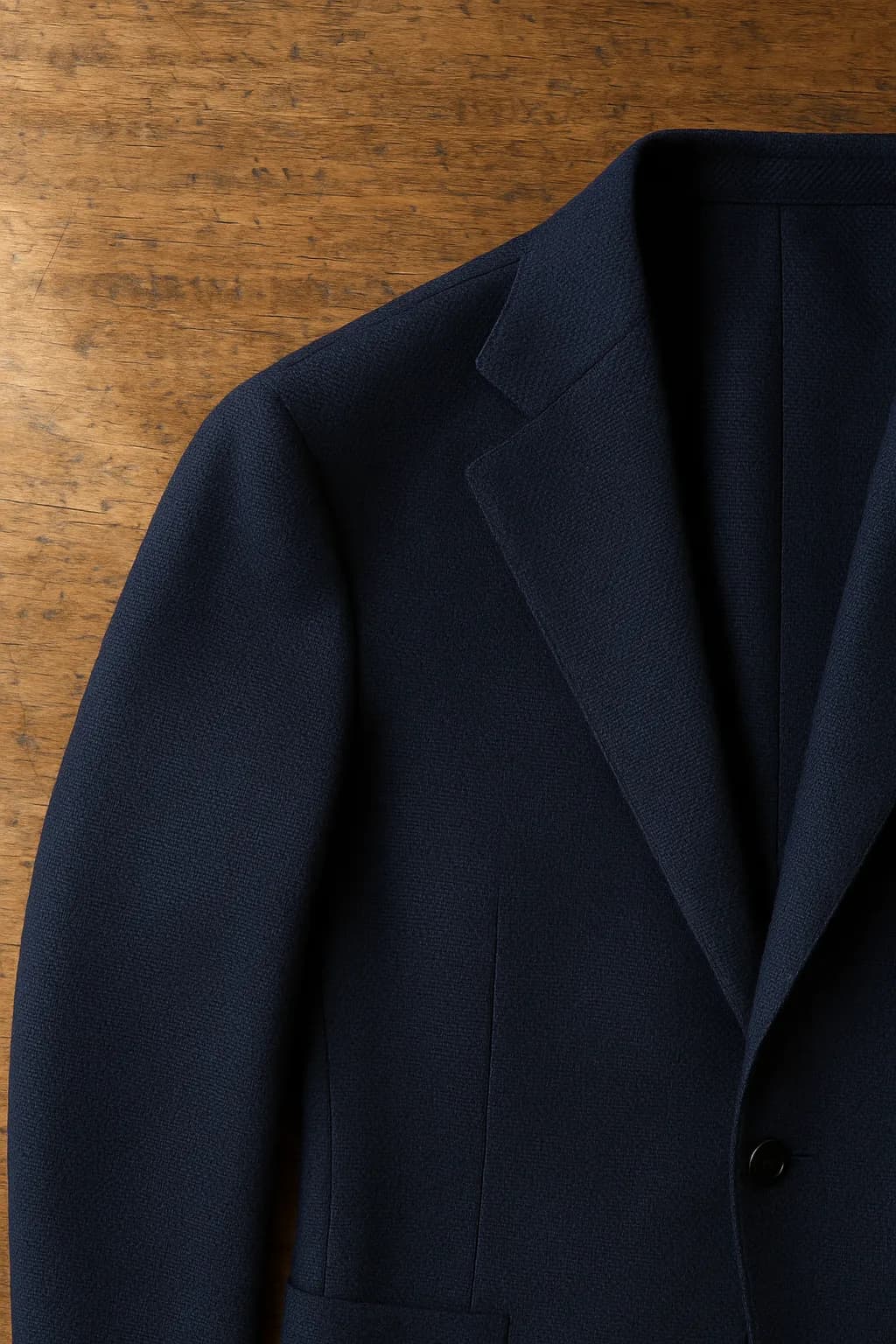
The jacket
Shoulders first, then length, then everything else.
The bottom button of a single-breasted jacket stays undone.
A jacket covers the seat. Cut short, it draws the eye to the hips, even when the cut is slim.
A longer skirt also lets the pockets sit lower, so the arms hang easy.
Read all 94 rulesClose the list
Fit the shoulders first, and never too narrow. Then set the length. Much of the rest can be altered afterwards.
Shoulders are the hardest part to change later.
A jacket is judged by its whole silhouette, its curves, lines and proportions, not by small signature details.
A well fitting jacket keeps its collar on the neck as the arms move, its chest flat, its shoulders ending near the joint, with no ripples.
A jacket sleeve ends at the wrist joint, and a quarter to half an inch of shirt cuff shows beyond it.
Lambskin is softest but tears most easily, goatskin is tougher and pebbled, and cowhide and horsehide are toughest, stiff and heavy.
Choose the hide for the use.
The softer the shoulder, the more casual the jacket looks. A natural, lightly padded shoulder suits relaxed wear but is less suited to serious business suits.
Shoulder construction sets formality as much as cloth does.
A jacket's lining lets it slide on and off, adds some warmth and hides unfinished seams. A partly lined jacket needs taped seams where they show.
A jacket is cut with room for a sweater underneath. Test it over the knit you mean to wear.
Fewer internal layers shed heat better, so a lightly built jacket feels cooler in warm weather.
Lapel curve follows the silhouette. A slim, clean suit with narrow lapels looks wrong with a strong curve; a draped jacket often gains from one.
On loosely woven cloth, flap pockets hold their shape. Patch pockets sag with time.
A jacket with patch pockets usually suits a casual edge finish, double picked or swelled.
Lined sleeves let an otherwise unlined jacket slide over a shirt without catching.
A backpack strap pulls at the shoulder line of tailoring. Carry a slim folio or briefcase instead.
A slim wallet in the inner breast pocket leaves the jacket line clean.
A field jacket is long enough to be practical and short enough to move in.
A tailor works best in their own house style. A cut they are not known for rarely looks good, even when they agree to make it.
A tailor you trust is useful, since most men lack the experience to judge balance and fit.
Wear a Teba or similar casual jacket with relaxed fit alongside corduroy, jeans or chinos.
An X-shaped crease across the buttoning point shows a jacket is too tight. Pulling, wrinkling and lapels lifting from the chest say the same.
Cutting a jacket too small makes a man seem larger than he is.
A gorge set level with the shirt collar points looks classic. Placed up near the shoulders, it becomes distracting.
Check jacket length by letting the arms hang: the hem reaches about the second knuckle of the hand and covers the seat.
The buttoning point sits just above the waist, near the navel, or slightly higher. At the sternum it gives an odd profile.
Classic length puts the hem about midway from the neck to the ground.
A jacket that is too long often sags at the neck as well. A shorter body, higher buttoning point and cleaner collar correct both.
A lower buttoning point stretches the lapel and pulls the hem down. Lengthen the jacket with it, or the proportions tip.
A higher buttoning point shortens and widens the lapels. A lower one lengthens them and draws the eye across the chest.
A soft shoulder that slopes and extends a little past the natural line gives the frame a V shape and makes the waist look trimmer.
A soft jacket keeps a little fullness in the chest rather than clinging to the body, with a sloping, slightly extended shoulder.
A rounded, natural sleeve head is pressed smooth. A visible bump at the shoulder seam marks a structured jacket pressed badly.
A symmetric pattern on uneven shoulders leaves an uneven hem when open and drag lines at the button.
A strongly built-up chest comes from layers of haircloth inside, not from the wearer. Too many layers make a jacket look overly chesty.
Haircloth running from chest to hem makes a jacket a little heavier and gives the skirt more shape. Canvas kept to the chest feels lighter and more relaxed.
A high armhole gives the arm more freedom. Soft canvas adds to the comfort.
Straight lapels look sharp but can seem to jut out when the jacket is closed. A slight curve looks more natural.
A lapel with strong curvature, set by ease and tension in small hand stitches, looks as if it blooms from the buttoning point.
A wider collar helps the lapel notch sit up under the face.
Moving the neck point forward by about half an inch throws the cloth back and gives a straight-cut jacket its drape.
A draped jacket gathers extra cloth in vertical folds around the armhole with a fuller chest. A clean-chested one lies close to the body.
Shaping the chest with a dart under the arm, not at the front, keeps checks and stripes unbroken.
A slimming jacket sits close at the waist and skirt, with sleeves near the arm and a slightly fuller chest.
A separate side body panel lets the tailor shape the waist and spreads the strain across more seams.
A wedge cut through the pocket holds a jacket closer to a larger body and keeps a clean line down the waist.
Fewer cuff buttons signal a more casual jacket. A single button belongs on sport coats and informal suits, set a little larger.
Two cuff buttons look intended when spaced apart. Set tight, they look as if buttons were left off. Touching buttons kiss; overlapping ones form a waterfall.
Edge stitching about a sixteenth of an inch from the edge keeps a jacket edge flat and crisp.
Heavy-handed pick stitching on a machine-made jacket looks worse than good plain machine stitching.
Hand pad stitching shows as herringbone stitches. Machine padding shows straight, parallel lines angled the same way.
Small snaps at the corners of linen pocket flaps hold them flat, since linen flaps curl over time.
A double-breasted jacket worn open adds volume and shape through its swinging fronts, like a cardigan with better shoulders.
Florentine jackets run to a wider, straighter shoulder than Neapolitan ones, which are rounder and narrower.
Milanese tailoring is structured and angular, Neapolitan soft and light, and Florentine sits between them.
Lapel shape differs by school: English lapels bow outward, some Neapolitan ones curve inward, and others run straight.
Much of the style of a jacket lives in what stands off the body: chest swell, extended shoulder and the flare of the skirt.
A safari jacket reads as a jacket when the cut is slouchier, with larger front buttons, bellows pockets and a side panel for shape.
A Teba is a country jacket with little padding, shirt-like sleeves, no vent and notchless lapels. Each trait keeps it casual.
A pleat at the centre back of a shirt-style jacket gives the arms room to move.
Move a tailor toward your taste in small steps, one or two changes per order, not with a long list at once.
Fit and shape are separate choices. A jacket that fits cleanly can still be cut as a column, an A, a V or an X.
Shape is where personal style begins.
A shirt-soft shoulder follows the body closely, so it can look less flattering over heavily sloped shoulders or a rounded back. A structured shoulder gives more shape there.
Structure under the surface hides what the wearer dislikes and shows what he likes.
A shorter jacket makes a man look heavier unless he is lean with shoulders broader than the hips. Shorter is not always slimmer.
A jacket with almost no inner structure needs a narrower shoulder. Push the shoulder outward and the tips cave in over time.
Most men carry one shoulder lower than the other, usually on the dominant side. A tailor can level it, but heavy padding looks awkward.
A jacket with no chest piece hangs like a shirt and hides nothing. It suits casual wear and packs flat for travel.
Heavy structure smooths the cloth and makes fitting easier. A soft single canvas shows wrinkles more and depends on careful fitting.
A jacket worn with no vent can ride up when the hands go into the trouser pockets.
A tailor can trim a bellied lapel straighter later. A straight lapel cannot gain a curve.
Drape cut well looks subtle. Heavy exaggeration is what gave the style its name for untidy tailoring.
A back with no centre seam keeps stripes and checks running unbroken. The cost is less shaping, and it is harder to alter later.
A very athletic build with a large drop from chest to waist may need the centre back seam for enough shaping.
A big difference between chest and waist may call for two darts in the front instead of one.
A jacket with straighter, undarted sides forgives many body shapes and does not depend on an hourglass figure.
A figure with a larger stomach needs a longer front, or a standard jacket rides up and looks too short.
A man of less athletic build can gain from extra room across the shoulders and chest.
Formal suits take one row of stitching at the edge. Two rows are showier and casual, and read best on plain cloth.
A swelled edge, with the stitching set inward so the edge puffs, is a sportier detail. It shows best on dense, heavy cloth.
Flapped welted pockets make a tweed jacket look more refined than patch pockets.
Patch pockets suit a lightly lined jacket, since welted pockets would expose the pocket bags or need extra cloth.
Half-lined, quarter-lined and unlined are not fixed terms. Describe the lining you want to the tailor in detail.
Buttoning a jacket can define the waist, most of all on soft, lightly structured ones.
A shorter double-breasted blazer looks more modern than a long one. Cuts made for single-breasted wear can make it look tight.
An odd jacket can look cut short, since matching trousers no longer carry its line on down. Suits usually look better than odd combinations.
English tailoring leans on precise cutting before sewing. Southern Italian tailoring leans on precise fitting on the body.
Sleeve length, shoulder placement and front-to-back balance are hard to change in a leather jacket, so the pattern has to be right.
A long field-style jacket is built to go over a sport coat and a chunky sweater, so outer layers need room above tailoring.
Workwear-style sleeves and shoulders allow freer movement.
Wear a new jacket for a while before changing its details. Taste settles with time, and going back to correct a first order rarely helps.
Soft tailoring comes from thin pads, light canvas and little lining. The softness is in the whole silhouette, not only a relaxed shoulder line.
An extended shoulder does not need heavy padding. A soft slope with slight extension is possible with little wadding.
Hand-padded lapels are hard to tell from machine-padded ones, except in very light cloth, and machine work is sometimes better.
Hand-sewn armholes are said to stretch with the arm, but one test found little give, since the front edge is tacked into canvas.
Buttoning a double-breasted jacket should be judged by whether the upper body reads broader than the waist, not by the wrap-over at the middle.