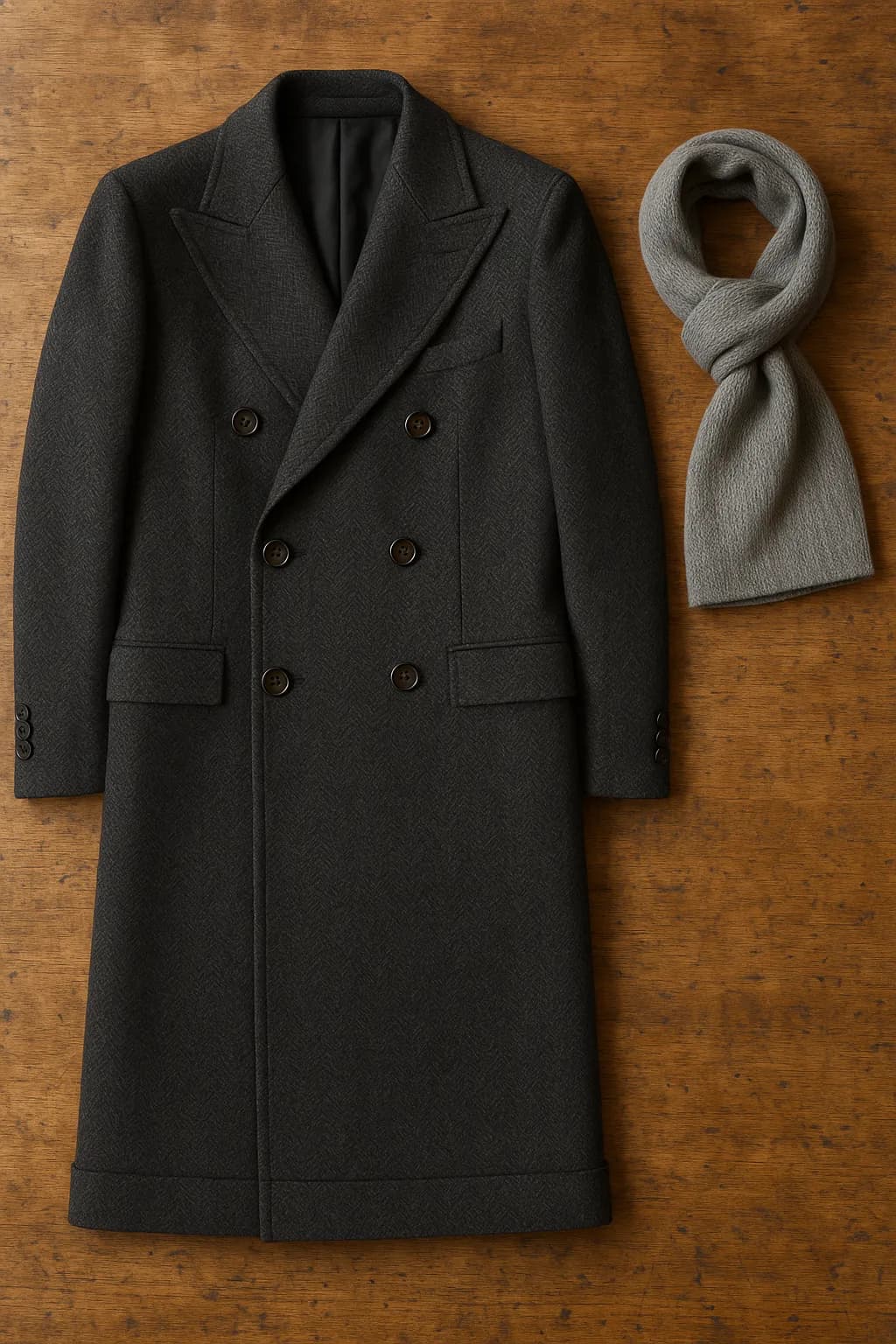
The coat
Cut with room, worn over everything else.
An overcoat is cut with room. Slim and short versions look tubular and lack the presence of a long, roomy one.
A coat meant for casual wear fastens higher up the chest and carries slim lapels, so the collar can be turned up.
Read all 45 rulesClose the list
A roomy overcoat needs a chunky, textured knit underneath, or the coat swallows the body.
A roomy or vintage-shaped coat looks best against slim, tapered trousers, which give the outfit shape.
A coat for tailoring needs enough chest and shoulder room, since those areas are hard to let out.
A coat that ends at the knee or below shields more of the body than one that stops mid-thigh. A raincoat reaches mid-thigh at the least.
Single-breasted coats usually look better open. Double-breasted coats go either way, though the fuller front suits being fastened.
A belted wrap coat looks better open, with the belt hanging loose behind.
A trench is cut long and roomy so tailoring fits beneath.
Shearling looks best loose, over plain easy clothes, above slim-straight jeans and heavy boots.
A chunky knitted cap balances a bulky coat. A thin one can shrink the look of the head.
A plain pullover anorak front can look bare, so a chunky turtleneck adds interest at the neckline.
An overcoat turns dressier with peaked lapels and welted pockets, and more rustic with patch pockets and a heavy tweed shell.
When trying on an overcoat, bring the jacket you will wear under it. It can feel too big over a sweater yet fit well over tailoring.
Length, waist and sleeves of an overcoat can usually be altered without much trouble.
In profile, the front hem hangs level with the back or a touch lower. A front that rides up means a poor fit.
Set-in sleeves give a squared, defined shoulder. Raglan sleeves are rounder and more casual, and hide a roomy fit.
Raise the collar from behind to see whether it frames the face.
A pleat in the back of an overcoat adds ease for movement, and an A-line cut gives shape without a belt.
A polo coat differs from other tan double-breasted overcoats by a lowered buttoning point that lengthens the lapel line.
Hand pick-stitching leaves soft dimples. Machine imitations can look as if applied with a nail gun.
Ivy-style overcoats show a hard, unbroken line of machine stitching parallel to the lapel edge and a plumper edge.
Topcoat cloth is lighter, for spring and autumn. Overcoat cloth starts at about 22 ounces and adds clear warmth and weight.
Stiff, heavy coat cloth holds a clean shape. Light, soft cloth hangs like a tube but moves more.
Test heavy tweed by pinching and rolling it. Good cloth feels solid yet soft and springs back.
A coat for weather has a collar that fastens to the neck and a dense shell such as gabardine or heavy tweed.
Beating wool to raise a textured surface, as in some Italian coatings, makes it warmer and more durable.
Warm outerwear works by trapping air. Down and spongy synthetic fill beat heavy wool, and wool beats cotton.
Quilted stitching in a down jacket keeps the insulation from sliding to the bottom.
A deep-pile fleece resists wind and water and breathes through a mesh lining, which suits unpredictable shoulder seasons.
Dry, cracked leather and a blocky shape make a shearling coat look dated.
A wool shirt-jacket covers cool days when a coat is too much. Size it to fit over a light sweater; a tailor can trim extra fullness.
In moderate cold, several thin layers adapt better than one heavy coat, which can be too warm on merely chilly days.
Three things make a leather jacket look more severe: black colour, stiff cowhide and a motorcycle cut. Lambskin and a bomber shape feel softer.
A mac has no epaulets or gun flaps, so it moves between tailored and casual dress. A trench sits best over tailoring.
A coat that clings to the shoulders looks dated. Cut it loose and slightly oversized.
A mid-thigh coat suits constant car travel. A knee-length coat adds drama but can bunch when seated.
A single-breasted coat worn buttoned needs interesting detail across the front to hold the eye.
An unstructured overcoat gives the face-framing lapel of tailoring without a suit shoulder, so it works over a suit or a chunky sweater.
A topcoat dresses up almost any outfit, denim included. A dense, slightly felted wool also copes with drizzle.
Down is lighter, warmer and packs smaller than synthetic fill, but loses its warmth when wet. Synthetic fill keeps warmth wet and cleans more easily.
A higher fill power down coat is warmer but less useful in humid or wet weather.
A puffy down jacket looks best with a roomier, rounded body in a rugged wardrobe, not slimmed down.
Membrane shell fabrics breathe far better than waxed or bonded cotton, so they suit cool, damp days that are not truly cold.
A set of cropped, light utility jackets give texture and shape in warm weather.