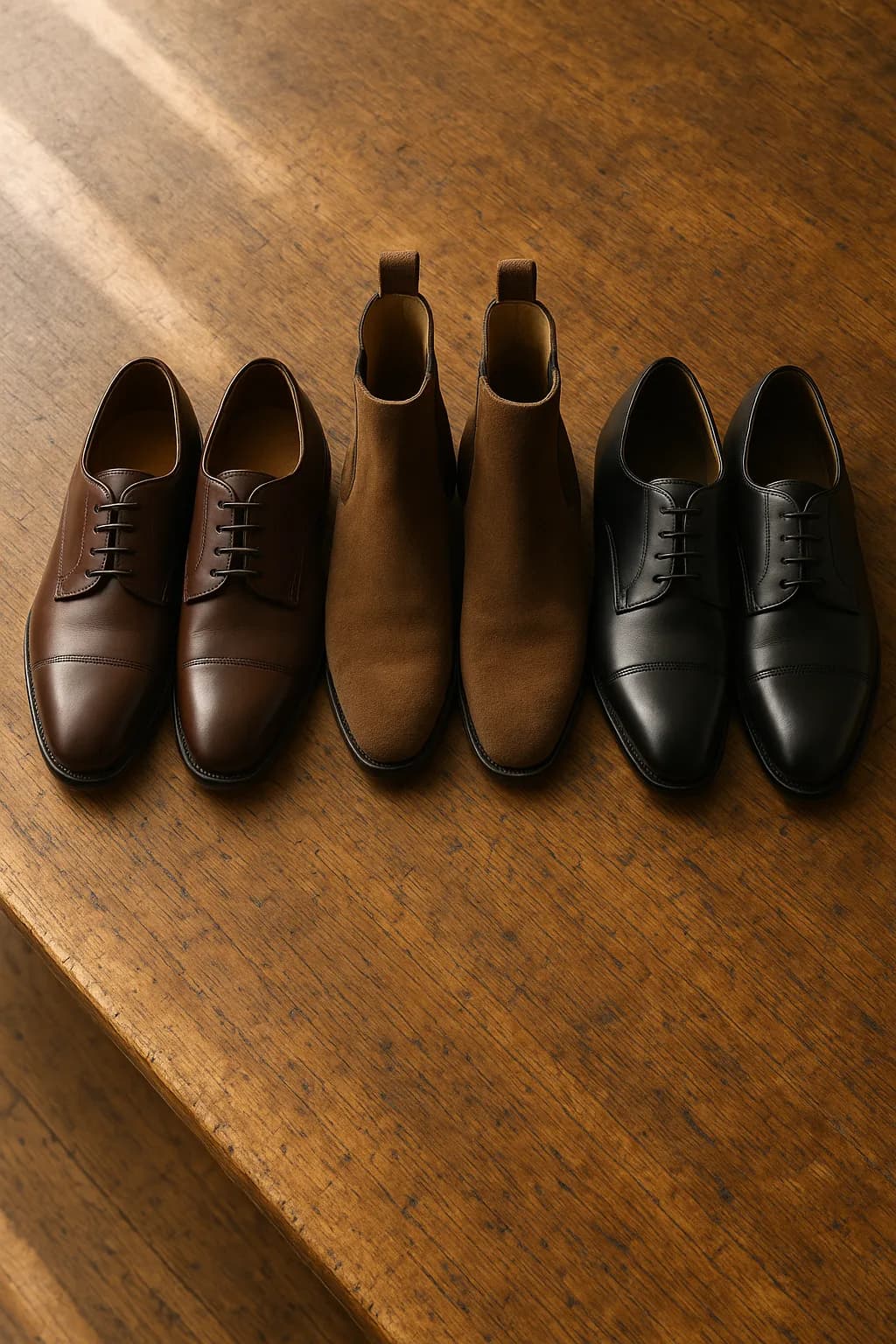
Shoes and boots
Weight at the ground sets the tone of all above it.
Chunky, brogued country shoes sit well under heavy cloth: cavalry twill, corduroy, tweed, flannel or denim. Sleek city oxfords belong with business suits.
Weight at the ground should match the weight of the cloth.
Black shoes suit faded, washed-out jeans better than brown.
Read all 142 rulesClose the list
Shoes lighter than mid-brown draw the eye down, and most men want the eye drawn up to the shirt, tie and jacket.
Oxfords can look too formal with sport coats and jeans. A derby is less sleek, so it fits odd trousers and everyday separates better.
Most men spend more time in separates than in full suits.
A suit can take more casual shoes: Chelsea boots, tassel loafers, split-toe derbies. Oxfords do not travel down to jeans; the wider the formality gap, the more jarring.
Fine oxfords with blue jeans look worst.
Choose shoes to suit the outfit's colour, season and formality, so no single item grabs attention on its own.
Shoes chosen as standalone objects often clash with the wardrobe.
Shoes can be stretched in width but not in length. Lengthening risks damaging the stiffeners at toe and heel and shifts the shoe's fit points.
The insole cannot lengthen, and fit depends on how the foot sits in the shoe.
A good sole follows the narrow waist of the shoe. A thick, chunky, studded sole on a slim shoe looks clumsy.
A bevelled sole that matches the waist keeps the line clean.
Good dress shoes look best after years of wear, once patina and scuffs have built up. Sneakers usually look their best when new.
Break-in and patina cannot be bought.
Canvas sneakers with a thicker sole suit heavy workwear better than thin, modern versions.
The shoe should carry the same heft as the clothes.
A moderately shaped shoe suits many trousers, from flannels to jeans. A very sleek, narrow one looks right only under slim tailored trousers.
The shape of the shoe sets the trouser width it suits.
Let sneakers dry fully for a day between wears and stuff them with tissue to hold shape. Damp material breaks down as it flexes.
A heavy, triple-stitched welt makes a shoe more weather resistant and more casual. Visible stitching adds bulk and ruggedness.
Bespoke shoes are measured in person, though later fittings can sometimes be done remotely. Makers size differently, so try shoes on or buy where returns are easy.
Penny loafers sit between sneakers and wingtips in formality. They work with jeans, casual jackets and sport coats with odd trousers, but not with dark business suits.
A loafer with higher side walls looks good with moleskin and corduroy trousers in the cooler months.
Tan shoes work with a pale grey suit, as they are darker than the trousers. With navy they nearly always look wrong, as the contrast reverses.
Tan shoes need a wardrobe with lighter suits, sport coats or casual clothes to go with them. Without those, mid and dark browns go with almost everything.
Shoes cut close to the foot with hard stiffeners leave little room for error, so try them on in person. A wrong fit makes the break-in painful.
Cheap corrected-grain leather looks poor after one season of wear. Glued-on soles are also a weaker build than stitched ones.
Plain shoe designs rely on silhouette and last shape, so proportion matters more than ornament in them.
A regular welt is enough for light rain and city use, and it keeps the profile manageable under tailored trousers.
A heavy leather makes a heavy shoe, which can look out of step beneath light trousers.
The split-toe derby began as a practical water-resistant shoe, so its natural home is casual and country dress.
A suede chukka with a crepe sole works with casual suits, blazers and jeans, and few settings make it look wrong.
A mid-brown shoe without red undertones is easier to wear with the cool greys and blues in most wardrobes. Reddish brown reads warm; bluish or greenish brown, cool.
A plain single-monk shoe sits between a double monk and a lace-up in formality. Dark calf dresses it up, light suede down; it suits a casual sport coat.
A gunboat-shaped longwing brogue works with a wide range of trousers, from classic flannels to slim jeans.
Burnishing should add depth without turning showy. Heavy two-tone rubbing reads as flashy.
White sneakers are the easiest to coordinate. Coloured pairs get worn less because they take more thought.
A loafer with a short, blunt toe and hand-sewn apron is relaxed enough for jeans. A slender toe and machine-sewn apron look urbane, with jackets and grey trousers.
Toe shape and apron set the formality.
An unlined loafer on a rounder last is more casual than a lined one on a sharper last with a smooth apron. The latter suits only dress trousers.
For dressier outfits choose loafers on a sleeker last. Chunkier, high-walled ones suit casual dress, and sleek loafers pair better with tailored trousers than with jeans.
Last shape sets how formal a shoe looks.
Retro running sneakers look best with slim jeans; baggy jeans push them towards a dad look. Classic outerwear suits them, and a topcoat dresses them up.
A shoe-boot hybrid looks odd under fine worsted trousers. With a suit it works only when it still reads as an oxford.
Horsebit loafers bridge casual and business wear and beat an oxford under a summer suit. They suit light sport coats; slip-ons can look louche or preppy.
Dark brown lizard loafers suit casual suits and slim belts. Brown exotic leather is distinctive yet discreet beside ordinary leather in unusual colours.
Heavier clothing needs shoes that look weighty too. Light suede slip-ons look feeble beside thick denim and flannel.
New leather sandals, especially closed-toe ones, need a few weeks of occasional wear to shape the footbed.
Plain shorts go with simple classic shoes: slim sandals, supple penny loafers or unmarked canvas sneakers.
Slip-on shoes worn bare-ankled have a relaxed warm-weather character and pair with shorts, summery shirts and light knits.
Casual outfits take rounded, comfortable shoes better than narrow, mirror-polished dress shoes.
A heavy topcoat is balanced by a chunkier shoe, such as a shell cordovan loafer, better than by a sleek one.
Loafers, boots and suede, or low-profile sneakers without a big sole, suit tailored trousers and avoid a bank-clerk look.
Judge shoes by their make, not by famous owners or a famous name. The technical work of the maker is what counts.
Choose a maker for skill and for the ability to steer you towards a design that lasts.
Tassel loafers look best with clothes cut neither too full nor too tight. Baggy clothes make them look fusty; very tight clothes make them look trendy.
A tassel loafer pairs with a navy sport coat and chinos in spring, and with tweeds and flannels in autumn. In black it sits between formal and casual.
Pick a shoe up by the middle, near the laces, rather than by the toe, to avoid marring the polish.
A new, narrow-heeled loafer can scrape the ankle at first. Wear it in with thin socks on short walks until the leather softens.
Hand-drawn foot tracings and self-taken measurements are unreliable, so ordering shoes or boots from them often gives the wrong size.
People hold the pen differently and cannot trace curves steadily.
Black boots suit military-style outerwear, dark rugged denim, leather, slim black jeans, trim grey trousers and loose topcoats. They can beat brown shoes in all-grey outfits.
A black Chelsea boot works from navy suits and grey flannels down to casual wear.
Suede copes with rain once sprayed with waterproofer; full-grain calf copes better when treated with oil, fat or wax.
Choose plain, classic hiking boots for casual clothes. Heavily technical versions look out of place.
A black side-zip boot sits between casual and refined. It suits modern leather jackets and grey topcoats, especially in black and grey outfits.
A plain-toed boot with a regular heel works with most work outfits. A raised heel with decorative stitching is more distinctive and fits fewer outfits.
Plain-toed boots with a flexible workwear spirit can be dressed from tailored trousers down to jeans and chore coats.
Slim buckled boots go with very slim trousers. A wide or generous leg needs a chunkier boot to fill the opening and keep balance.
Work boots can be worn hard with only occasional conditioner and a damp wipe, because visible age is the aim for that type of boot.
Heavy use makes them look better.
Engineer boots need a trouser leg wide enough to clear the shaft. They pair better with vintage-inspired workwear than with tailoring.
Next to heavy boots or tall sneakers, hem slim-straight trousers a little shorter so the footwear shows.
Rubber soles, or a thin rubber protector over leather, wear better on wet streets. A full rubber sole looks wrong on dress shoes.
In heavy rain or snow, wear footwear built for the weather and carry dress shoes in a bag, or keep a pair at work.
Brown chukkas look better in suede or pebbled leather than in smooth calf. The texture breaks up the plain vamp and suits rustic tweeds.
Black calfskin shoes suit evening tailoring; brown suits the day.
The last shapes the shoe. An almond toe reads conservative; a narrower body and toe box looks sleeker at the same length, without being longer.
A deeper curve at the waist, hugging the arch, with the sole trimmed close to the upper, looks sleeker than a standard machine-welted shoe.
Dirt and dust emphasise creasing. Cleaning leather and suede makes the surface look smoother and less tired.
A square waist, bellows tongue, wide welt and slightly proud sole mark a country shoe. A curved, bevelled waist and a close welt look more refined.
Each set of details matches how the shoe is meant to be worn.
Finer stitching at a higher stitch count gives cleaner lines on a shoe. Cheaper work uses fewer stitches to go faster.
A flat, machine-sewn apron can make a split-toe shoe look cheap. A hand-sewn apron looks richer.
A channelled sole hides the stitching under a thin flap of leather. It is a small detail once found only on expensive shoes.
Rest shoes for a day between wears, keep cedar trees in them, add conditioner when the leather looks dry, and polish to bring up shine.
A refined dress shoe is shaped: a snugger waist, a raised arch, a low vamp and a curved heel, not merely a pointed toe. Fit tolerance is small.
Warning signs in a shoe: thin cheap leather, loose stitching on the sole, glue showing near the heel and rock-hard insoles. A good origin does not guarantee quality.
An oxford has closed lacing, with the eyelet tabs sewn beneath the vamp. A derby has open lacing, with the tabs sitting on top.
Faults to check on new shoes: a sagging waist with a gap under the middle, a heel so loose a finger slides behind it, and wrinkled uppers.
Left and right shoes should match in detail, such as skin pattern and back seams. Matching is a sign of careful work.
Welt stitches spaced too widely let the welt pull away from the upper after wear, leaving threads visible around the edge.
Wide spacing saves time but needs tighter thread tension.
A lumpy toe puff is a quality warning in new shoes.
Most pull-on ankle boots have seams at the sides and back so the maker wastes less hide. A boot cut from one piece looks smoother but costs more.
For wet weather, judge a boot by three things: the upper material, the sole and how the sole is attached.
Corrected-grain leather has a plastic-looking shine and an absent or embossed grain. Full grain feels like leather, not enamel, and shows depth of colour.
Corrected grain creases harshly, breathes poorly and its finish can flake.
Good suede has a firm, dense nap of even-length fibres. Long naps turn ragged and wear bald, and a greasy feel is a warning.
A hand-cut upper lets the maker place the grain with care, so the leather creases more finely than leather stamped out by machine.
Ready-made shoes are rarely shaped well at the waist and arch. Extra handwork, or a hand-welted build, allows a narrower waist and more arch.
Machines limit how far the sole and upper can be shaped.
Unlined suede and unlined leather shoes are soft and relaxed, need little break-in and suit hot days. They hold their shape less well than lined pairs.
Without an inner liner the upper has less structure.
Many shoes sold as unlined are partly lined, so softness varies from pair to pair. A full leather lining adds support and keeps the shape for longer.
A hand-sewn shoe can be resoled many times, as stitching holds the sole to the insole. A glued canvas rib in Goodyear welting can slip or fail.
A hand-welted shoe has a strong leather insole. Machine-welted shoes may use cheaper insoles, cork filling and plastic stiffeners that cannot be mended once crushed.
Machine welting needs no strong insole, so cost pressure lowers the materials.
Machine-welted shoes give good value at lower prices. Whether the extra comfort and resoling of hand-welted pairs justifies a far higher cost is open to question.
Hand lasting can follow the foot's natural off-centre curve all the way to the sole. A seamless lining removes a likely failure point at the heel.
Ready-made lasts serve many feet, so the underside is roomy and flat and the waist looser. A last that shapes the arch and bones fits better.
Shaping the waist is a more sophisticated way to give a shoe elegance than making the last pointier.
Waist shaping adds refinement without extra length.
The vamp is best cut from the tight-grained part of the hide. Softer leather nearer the neck wrinkles where the shoe bends, and this shows on casual shoes.
Light shoes also work in low-contrast outfits, or beneath a lighter jacket. Tan becomes the loudest piece of a dark worsted suit outfit.
Leather cannot be unpicked and restitched like cloth, so shoes are harder to adjust than clothes and sometimes need remaking.
Every stitch leaves a permanent hole.
A small change to a shoe, such as a sliver more apron, alters its look far more than a small jacket detail does.
Half-made shoes without heels or soles look longer and pointier than the finished pair. Judge the shape on the finished shoe.
A closer-fitting shoe can feel tight at first, as many men wear shoes too large. It may cause blisters before it settles.
The leather flexes nearer to the foot.
Ready-made shoes are enough for most feet unless there is a medical need. A first bespoke pair will not fit perfectly.
In bespoke shoes the last decides fit and shape, so clear talk with the last maker matters most. A last carries one foot and rarely suits another.
Everything after the last follows from it.
Leather heel and toe stiffeners mould to the foot and can be repaired. Factory plastic stiffeners are cheaper and arrive pre-formed.
Crust leather ages with unusual depth of colour, but it dulls quickly and needs regular polishing and a careful choice of conditioner.
Fine hand-stitched detail shows poorly on suede, because suede fibres are less dense than smooth calf.
On a derby, the tongue continues the vamp, so water runs over it. An oxford's facings let water seep in, which matters outdoors.
A bellows tongue is joined to the facings, so rain and mud cannot seep in. This is why country shoes have it.
Weatherproof welts trade comfort for protection. Veldtschoen is soft but the least waterproof; a Norwegian storm welt is heavy and slow to break in.
A made-to-measure shoe can hug the arch with a closer waist and a slimmer toe box and still be comfortable.
A flat butted seam on thin leather tears easily, while thick leather makes the shoe look chunky. Hide thickness limits how much apron styling a shoe can take.
In sneakers the build gap between cheap and expensive pairs is smaller than in dress shoes. Most of the difference is design.
Crossed straps and a dulled buckle make a single-monk look less monastic and less showy. A bright buckle shines like a coin.
A true moccasin joins separate side and vamp pieces by hand. A skin-stitched toe on a one-piece upper is only decoration, and it holds its shape.
Top-grain leather has fewer blemishes than full grain but feels less rich and supple, and its looser fibres can make it seem airy.
Shell cordovan is thicker than calf, so a loafer in it looks chunkier and rounder on the same last, and reads more casual.
The weighty shape and soft shine suit relaxed wear.
Affordable exotic shoes are usually caiman, or cut from poorer parts of the hide. A quality pair uses belly skin with matched patterns, so it costs more.
For fit, the heel-to-ball distance matters most; the rest of the shape can be styled freely. A looser cut gives up arch support.
Some pairings work through convention rather than colour theory, such as burgundy shoes with a navy suit.
Quality slips when makers are paid too little per pair and have to hurry. Small independent makers often do better work than large famous houses.
A last carved from a rough block allows a wider range of shapes than one built up from a standard fine turn.
A shoe's details should serve a function. A straight-cut jockey heel on a riding boot, for example, keeps it seated in the stirrup.
Leather soles wear quickly on wet pavement but grip better than rubber on slick indoor floors. Lugged soles combine the two advantages.
Black suede suits cooler months and evenings, and looks wrong in spring or summer. It sits well with grey flannel or navy pinstripe. Black calf is more versatile.
Slim glued soles give a sleek line, but such shoes can be resoled fewer times than stitched ones.
A boot sole that is screwed on rather than welted can still be resoled and allows a thinner, sleeker profile.
Kangaroo leather is soft, thin and strong but wrinkles more than calf, so it suits rugged casual wear more than tailoring.
Boots with high side walls often fit large even in the right size, and may need a padded insole.
Black shoes are standard under navy and grey suits. Black also works casually, especially in boots, beside navy and green. Its range is wider than the old rule.
Black suede creases less harshly than cheap smooth leather, so it hides weak build quality better.
Rubber is the most waterproof upper but does not breathe. Shell cordovan resists water well, though it spots; brush the spots out afterwards.
Norwegian and storm welts keep water out best but make a boot bulkier. A plain Goodyear welt handles ordinary rain; Blake-sewn soles can let moisture through.
Scuffed, wrinkled leather on a boot reads as charming patina. Good full-grain leather ages rather than merely creasing.
Pale footwear is trickier than dark. Jodhpur boots look distracting beside tweed and costumey beside waxed or quilted jackets.
Good winter boots can hide their weatherproofing: shearling lining, bellows tongues and buckle straps stay out of sight, so the boot reads as an ordinary one.
In heavy rain a tall boot stops water wicking up the calf from the hem and keeps splashes off the trousers. Rubber is easier to maintain than cordovan.
Wear a tight new pair for a couple of weeks before paying for stretching. Suede and calf stretch easily, while shell cordovan does not.
Leather often eases by itself.
Rubber overshoes slip over dress shoes. Rubber boots keep out rain but suit casual dress, not suits or sport coats.
Suede sits well beside soft-looking cloths such as flannel, corduroy and moleskin.
Going sockless suits loafers, boat shoes, moccasins, chukkas and canvas shoes. Oxfords are the exception.
Chelsea boots or plain white sneakers keep a leather jacket outfit relaxed.
Hand work in shoemaking is not a label. Terms such as handgrade or benchgrade name a price tier; Goodyear and Blake stitched shoes are largely machine made.