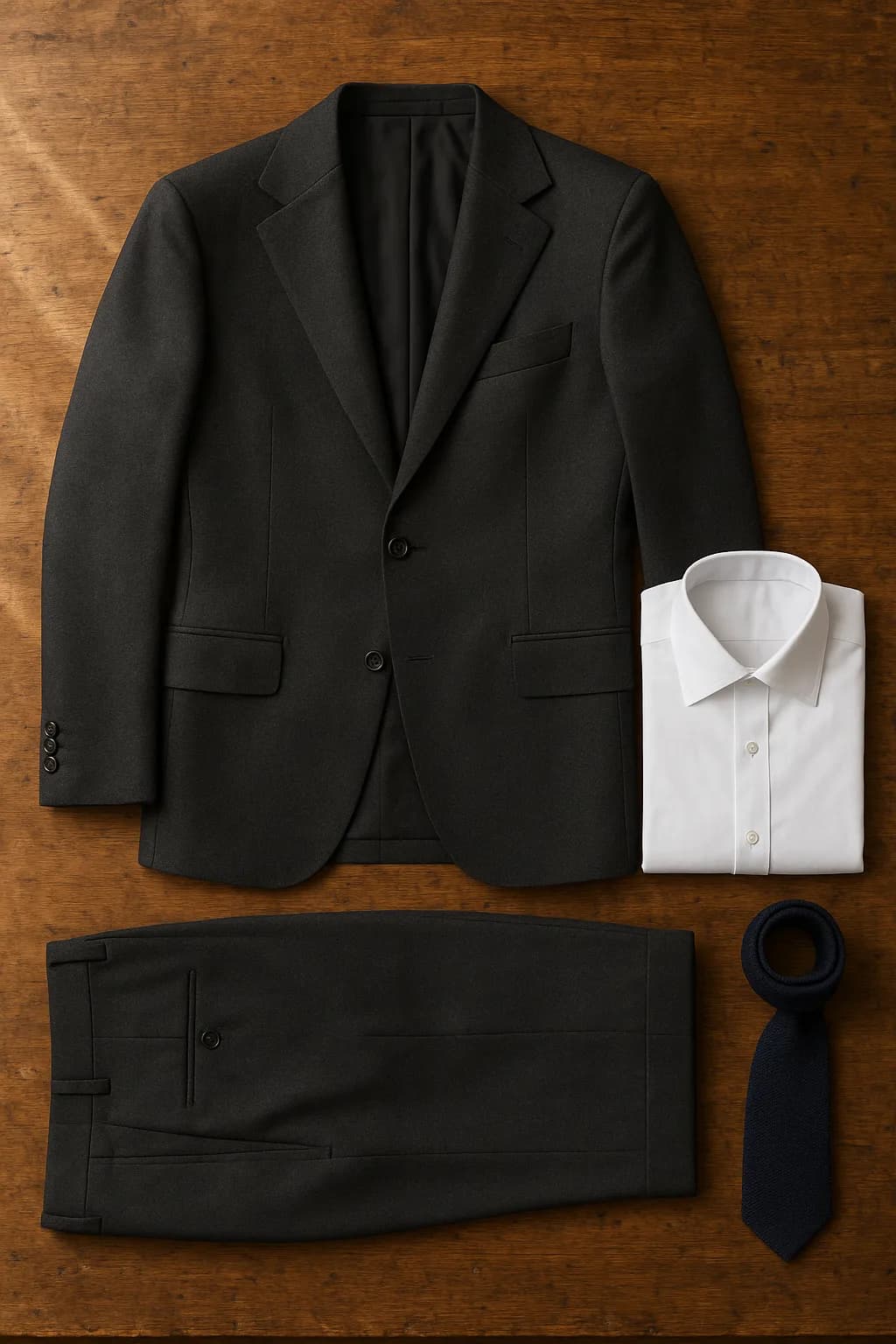
The suit
One cloth, top to bottom, and the reasons it still works.
A suit is a complete look in four-season cloth, in navy or grey. A separate jacket is where seasonal cloth and variety belong.
Own one serious suit first: dark worsted, single-breasted, navy or grey, notch lapels. The second can be livelier.
Read all 29 rulesClose the list
Pinstripe and chalk stripe belong to suits. So do birdseye, nailhead and tiny herringbone that looks solid from a short distance.
A coarse weave such as tweed can carry birdseye as a jacket.
A sober worsted suit resists being dressed down. A suit already made of cotton, linen, corduroy or tweed is easier than adding casual accessories.
Navy or grey suits are easier to wear than black ones, and a black dress shirt is doubtful.
A suit can split into separates when its jacket has patch pockets and the cloth is casual enough to wear alone.
For evening, lean toward elegance: sober charcoal or navy, refined cloth such as wool-mohair, and softly polished black shoes.
Wear a suit to an ordinary dinner. Dressing up without a reason is fine.
Buy fewer, better tailored pieces rather than many suits, since most men no longer dress in one daily.
A fine, flat weave with a smooth hand, faint diagonal lines and a slight sheen marks suit cloth. A rough, fluffy, open weave marks a sport coat.
Cloth shows what a jacket was made for.
Suit jackets take buttons near the colour of the cloth. Sport coats and blazers often take contrasting metal, horn or mother of pearl.
A sleeve with fewer than four buttons also leans casual.
The strictest business look is a dark suit, a white shirt, a dark tie and a white pocket square. Any departure softens the signal.
Off-the-peg uses averaged measurements. Bespoke drafts one pattern for one body, and that is the real difference.
Hand-sewn seams look livelier than flat machine seams, and generous inlays let a garment be altered later in life.
A tiny pattern on a suit adds interest up close but reads as a solid colour from a distance.
Colour carries social meaning. A pink shirt in place of white, or a yellow pocket square in place of white, changes what a business suit says.
A suit looks sleeker than a sport coat because the jacket flows into the trousers.
Patch pockets on a dark worsted suit read as too casual for formal settings.
A suit made with its pockets, shoulder and cloth in the same grade as bespoke can fit a standard figure almost as well.
A tweed suit sits awkwardly between formal and casual. Wear it casually or split it into separates.
A tan suit dresses up with a white shirt and a dark silk tie, or down with an open collar and a thin belt.
A green suit or jacket reads younger and more modern than navy or grey, with no need for strong pattern or odd proportions.
Suits suit a man best when the design matches his character, life and work, not only his measurements.
Made-to-measure starts from a block pattern, so it can fail for a body outside the range of that block.
Made-to-measure can correct complex points such as a lower shoulder and sleeve pitch. A hard-to-fit figure is best served by custom work.
A good base pattern can matter more than a skilled cutter, and a garment made straight to finish can fit better than one with many fittings.
Fully canvassed construction and handmade details mark quality, but a good outfit still needs a point of view.
The name sack suit does not mean a baggy fit. It describes a back cut from two fairly straight panels.
Ready-made, made-to-measure and bespoke are not a quality ladder. Each tier has good and poor examples.