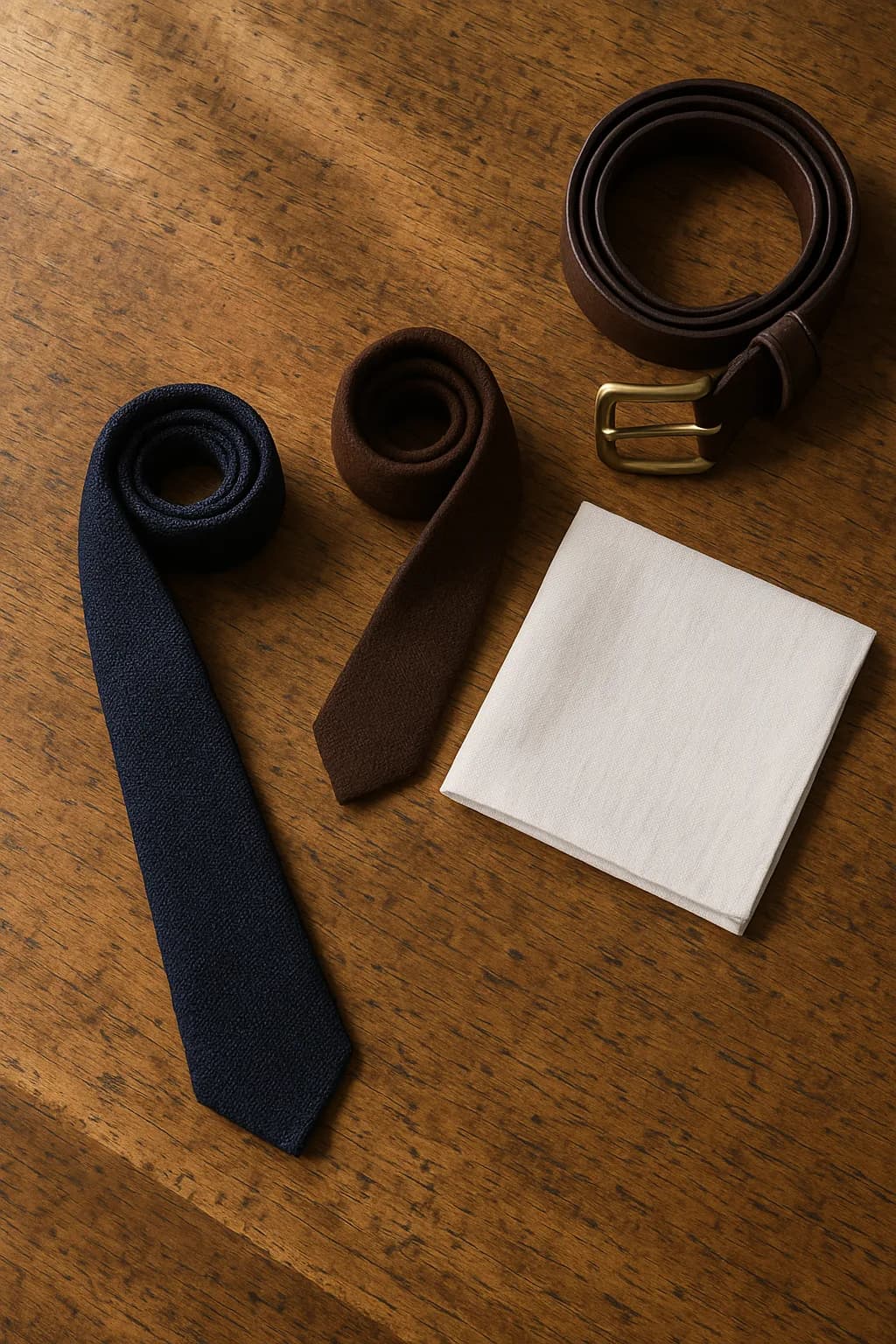
The tie and the small things
Ties, squares, belts, socks and gloves: small, and seen.
A dress belt echoes the shoes in colour and finish: black belt for black shoes, dark brown belt for dark brown ones.
A solid navy tie goes with nearly everything. It lifts dark suits and anchors patterned jackets, and texture makes it more interesting.
Read all 113 rulesClose the list
A small belt rotation covers most needs: stitched-edge dress belts for wool trousers, thick leather for jeans, plain bridle leather for chinos. Unusual closures and ribbon belts distract.
Sock colour traditionally either matches the trousers for an unbroken line or stays navy. Black is for a black suit and shoes only.
Matching creates a continuous line from hip to shoe.
A jacket looks better with something filling the open neckline. A scarf does the job when a tie feels too formal.
A first scarf in navy, mid grey or tan, with a plain pressed finish, goes with nearly everything.
A very wide scarf is bulky. Finer fibres and looser weaves reduce the bulk, and the largest scarves belong with heavy coats.
A big scarf looks less conspicuous under heavy outerwear.
A large scarf with a bold print looks assured when the rest of the outfit stays quiet.
For spring, choose an open weave scarf. Linen or modal blends feel coolest.
With one pair of gloves, dark brown soft leather with a warm lining goes with nearly everything.
Dress gloves for a suit are fine leather, unlined or silk lined, with seams turned inside for a slim line.
A heavy lining makes the hand look like an oven mitt.
Gloves sewn with the seams outside look bulkier and rustic. They suit tweed, cord and heavy outerwear better than a dress outfit.
Match a watch to the clothes: a tool watch for workwear, a slim leather strap for almost anything, a plain dial for formal dress.
Match jewellery to the whole outfit: spare pieces with spare modern clothes, chunkier handmade pieces with workwear, a plain signet with refined casual dress.
Yellow gold flatters warm browns, and silver flatters cool navy, grey and black.
With a suit or sport coat, keep jewellery sparing and quiet. Worn boldly, it argues with the tailoring.
A well dressed man avoids short ankle socks, tie and pocket square sold as a matching pair, oversized cufflinks and a tie clasp that shouts.
A backpack is too casual for tailoring and spoils the line of the jacket shoulder, however sleek it is. A slim folio is the better carry.
Straps drag and crease the shoulder.
Dressy brown or black leather bags suit tailoring. Cotton bags and unusual shapes suit casual clothes.
A cap with no logo is the most neutral choice. A more designed cap adds character to an outfit.
A first knitted cap in navy, black or grey goes with nearly everything. Muted earth tones add colour quietly.
Spectacle frames suit the proportions of the face: arms that do not flare at the sides, a bridge that stays put on the nose.
Fit comes first and style follows.
Too many details, accessories or pieces of jewellery draw attention to themselves instead of the man. Fit does more than extras.
A good belt is worth paying for. It lasts for decades and shows whenever the jacket opens or comes off.
A braided belt matches different shoe finishes easily, whether smooth, suede or pebbled. A smooth leather belt sits awkwardly beside suede shoes.
A belt is usually bought one size above the trouser size, and some run even shorter and need a further size up.
Classic tailoring puts the focus on the top half of an outfit, so loud trousers, bright shoes or odd socks pull the eye downward.
Fun socks work better with a tonal link to the outfit. Stripes, cables or marled yarns read as playful; slogan or joke socks read as novelty.
Navy long socks with a subtle texture, such as herringbone, are more interesting than plain navy yet stay office-appropriate.
Socks that stay up avoid pooling at the ankle. Three-quarter-length socks in a cotton blend do this well.
Patterned socks work when the pattern differs from the trousers yet shares their colours: fine herringbone under a chalk stripe, pin dots under a windowpane.
Neutral colours and traditional patterns keep it playful, not loud.
With a coat and tie, over-the-calf socks are the safe length. Mid-calf length suits casual jeans, and shorts take no-show socks.
Longer socks stay up, so no bare shin shows when sitting or crossing the legs.
Choose frames that offset the main lines of the face, softly: rounded frames for an angular face, angular frames for a round one.
Balance, not contrast.
A hat sits best with a smart, put-together outfit. It cannot rescue a careless one, and it comes off indoors.
Style is the whole picture.
Grey and silver ties are among the best with a navy suit. With grey trousers, avoid a tie that matches the trousers closely.
Silk pocket squares set off matt tweed, flannel and wool ties with their sheen, while wool or cotton squares balance silk ties.
Without a tie, keep the pocket square quiet and tucked low, because nothing balances a loud one.
Dark lenses without full UV protection are worse than none, because the pupil opens and lets more UV through. Look for UV400 or full UV protection.
Plain cotton socks in a muted colour suit sneakers better than dress socks. Plain white ones look like athletic tube socks and belong at the gym.
Dress socks look out of place with sneakers.
A good stitched belt is leather all through. Cheaper ones hide plastic or compressed paper inside, and a squared, neatly bevelled keeper marks careful work.
Belts can be shortened at the buckle end, which keeps the shaped tip and the holes, so a larger second-hand belt can be cut down.
A tie should spring back to shape after being knotted and untied. If creases stay at the neckband, it will become hard to wear.
A tie that cannot recover is faulty, not a matter of taste.
Thick wool socks keep feet warmer than cotton and wick sweat. Leave room in the shoe, since a tight fit restricts circulation and chills the feet.
A dress belt takes a plain buckle. Ornate buckles and D-rings are casual.
Without a tie, leave the top two shirt buttons undone for a better collar line.
A tie with a cotton weft in a silk warp is less shiny than pure silk, which suits linen jackets and hot days.
Dull finishes match summer cloth.
A rough raw silk tie looks casual and suits linen or cotton suits.
A black silk knit tie works all year with almost anything. It quickly relaxes a tailored jacket.
A wool or cashmere knit tie has a fuzzier texture that suits winter tweeds and flannels.
A cotton knit tie has a flatter, quieter weave than silk and gives a spring or summer feel with light tailoring.
Knit ties are softer and more casual than woven ones. For a first one, choose black; pointed ends make the length easier to judge.
In summer, ties are brighter in colour and thinner in cloth than winter ones.
A madder tie sits mid-range in formality. It works with tweed or cord jackets and worsted suits alike.
Paisleys and small geometrics are more flexible than big diamonds.
A repp stripe tie is versatile and stays in style for decades. It suits smooth suits and rough jackets alike.
Foulards and paisleys usually favour one or the other.
Striped repp ties suit casual suits and odd jackets. Small geometric prints suit formal worsted tailoring.
Tie pattern signals formality.
Larger tie patterns tend to be more casual. Near-monotone florals and paisleys feel light for summer.
Scale of pattern shifts a tie's formality and season.
Raw silk ties belong to spring and summer. Tweed, madder and cashmere ties belong to autumn and winter.
Tie cloth has a season, like jacket cloth.
A green, red and blue regimental stripe suits a plain navy jacket and a brown check sport coat.
A textured solid tie, such as a grenadine, pairs easily with patterned jackets and lifts plainer outfits.
Navy and deep green ties sit particularly well beside tweed and flannel.
With a tan suit and white shirt, a lighter tie in mid brown or cream works better than navy or black.
When balancing a loud outfit, tone the tie down rather than leaving it off.
A tie anchors a bold jacket or accessories.
Matching a tie to the jacket in a similar hue gives a low-contrast outfit that can say more than loud colour.
Less contrast pushes attention to line and silhouette.
A very wide cutaway collar looks forceful and calls for a large symmetrical knot, which sits poorly with relaxed tailoring.
A lightweight, slightly sheer silk pocket square suits cotton and linen jackets.
The light weave and gentle sheen match summer cloth.
A white linen pocket square goes with nearly any jacket but usually wants a neat, formal fold. A silk one looks casual in a puff.
Silk's sheen sets off the dull finish of wool.
A wool pocket square suits silk ties but feels autumnal. Cotton is the warm-season partner for casual suits and sport coats.
A good everyday pocket square print is distinctive enough not to echo any one tie, yet calm enough not to shout when worn alone.
A pocket square needs enough size that it does not sink into the pocket.
One small warm accent, in a pocket square for instance, keeps a cool tone-on-tone outfit from looking glum.
All-cool outfits can feel monotonous.
A contrasting scarf, such as grey over blue, stops a tonal outfit from looking flat.
One accent breaks monotony without losing harmony.
A thin gold chain of about three millimetres suits tailoring because it does not overpower the outfit.
A flat folio or slim bag keeps the shoulder line of a tailored jacket from being spoiled.
A pressed finish on a scarf looks neat beside tailoring. A tumbled finish looks soft and crinkled and belongs with weekend clothes.
Cheaper gloves show flat points on the back, visible stitching along the fingers and stiffer leather. Smooth leather gains a patina; suede only wears thin.
Jewellery carved or twisted by hand usually shows more depth and detail than stamped pieces.
Cheap alligator belts show small, ill-defined scales and crinkly leather, often from the flank or small animals. Better skin has uniform scales and crisp lines. Caiman cracks easily.
Caiman is often sold as alligator.
Saddle stitching gives a tighter seam with slanted stitches and no visible holes. Unlike machine stitching, it will not run if one thread breaks.
Fine bridle leather flexes yet keeps its form. It is finished on both faces so it will not chafe, with neat stitching at the buckle end.
Better socks have the pattern knitted in, not stitched on top, which avoids a bumpy texture against the foot.
Knitted-in designs sit flat and look more refined.
A dry hand and matte finish make a tie suit casual tailoring in cotton or linen. Handle it to judge the texture.
Texture is hard to judge in photographs.
Bouclé is made from looped yarn, which gives a spongy, slightly rough fabric. It is the colder-season partner to raw silk and suits tweed.
A tie with a thin wool lining and plenty of handwork hangs well and knots with character. A heavily padded tie is stiff and smothers the silk.
Too much structure takes the life from the outer cloth.
A tie in a thick cloth such as tweed needs a thin lining and few folds. Otherwise even a small knot looks as large as a Windsor.
Wool challis is soft without bulk, drapes well and ties a small, firm knot. It has a matte finish.
A silk woven with warp and weft of one colour shows purer, more luminous colour than one with a dark warp, which dulls the weft.
Ancient madder silk has a chalky, dusty hand. The matte feel is a mark of the cloth.
Under a bold jacket, a dark tie recedes more than a pale one. It sits well on a blue shirt without matching it.
Contrast decides how much the tie draws the eye.
A tie is undone by reversing the knotting steps. Yanking the front blade out of the knot damages it.
A pocket square in soft silk crepe stays put in a patch pocket without bulk. A stiff silk twill can balloon.
Saddle stitching, done by hand with two needles, makes a stronger seam than machine stitching. One broken stitch does not unravel it.
Good exotic leather has clean, even scales without fine fissures, and a careful maker cuts it so the scales grade smoothly in size.
Mid-century work shirts show cat-eye buttons, chain stitching at the seam run-off and a short spread collar.
With formal clothes, many people prefer a simple dial without complications.
A hat is easier to wear when it has a plain practical purpose, such as straw against summer heat or felt against rain.
A casual cap sits best with clothes between smart and casual: a raglan coat, suede boots, or loafers in place of oxfords or trainers.
A knitted cap with slack at the crown lengthens a round face. A small snug one can make the head look tiny.
Thin wire frames are often more comfortable than thick plastic ones. They weigh almost nothing and rest gently on the ears.
When heat rules out layers, small things carry the outfit: a collar shape, a belt strap, eyewear or jewellery, chosen with care.
With fewer layers, what remains gets looked at.
An alligator belt need not match the shoes exactly, but its colour should loosely agree with the footwear.
Exotic leather at the waist adds interest without being showy.
Hand-stained leather shows scuffs and scratches more than leather dyed through at the tannery, because the colour sits only on the surface.
Leather with less finishing, such as raw saddle leather, develops the most character with age. Heavily finished leather changes least.
Oils and waxes added at finishing slow the change.
Mercerised cotton socks wear cooler than wool and show crisper patterns, but they shine up with wear faster than wool does.
Wool socks felt when the fibres tangle and mat into fluff, yet well-made socks can still last years.
Pick a pocket square that echoes a secondary colour in the jacket or tie, or a neighbouring or opposite hue. A flat match looks forced.
A dress belt about an inch and a quarter wide looks normal with any trouser. Narrower reads as a fashion statement, and wider is casual.
Width signals formality, so the belt agrees with the trousers it holds up.
A bold tie can lift a plain suit, but a drawer of conservative ties in dark colours should come first.
Conservative ties in navy, brown and green work with most outfits; bold ones are extras.
Line gloves with cashmere or silk for deep cold. For cool weather, unlined gloves are less warm but fit better and last longer.
Lining adds warmth and bulk; the trade is fit and durability.
A rust tie is a quiet accent, more distinctive than navy or burgundy without being loud. It also sits well on a light blue shirt.
Rust is complementary to green but not red enough to look festive.
A knit tie about five centimetres wide can look right once the jacket is on. The relation of shirt, jacket and tie matters more than the number.
Proportion is judged on the whole outfit.
Something at the neck, such as a scarf, neckerchief or ascot, improves an outfit with no tie.
A necklace can do the job of a tie, adding interest and drawing the eye toward the face.
Small snaps, plain horn buttons and quiet cuff details signal a considered jacket, while showy details draw the eye.