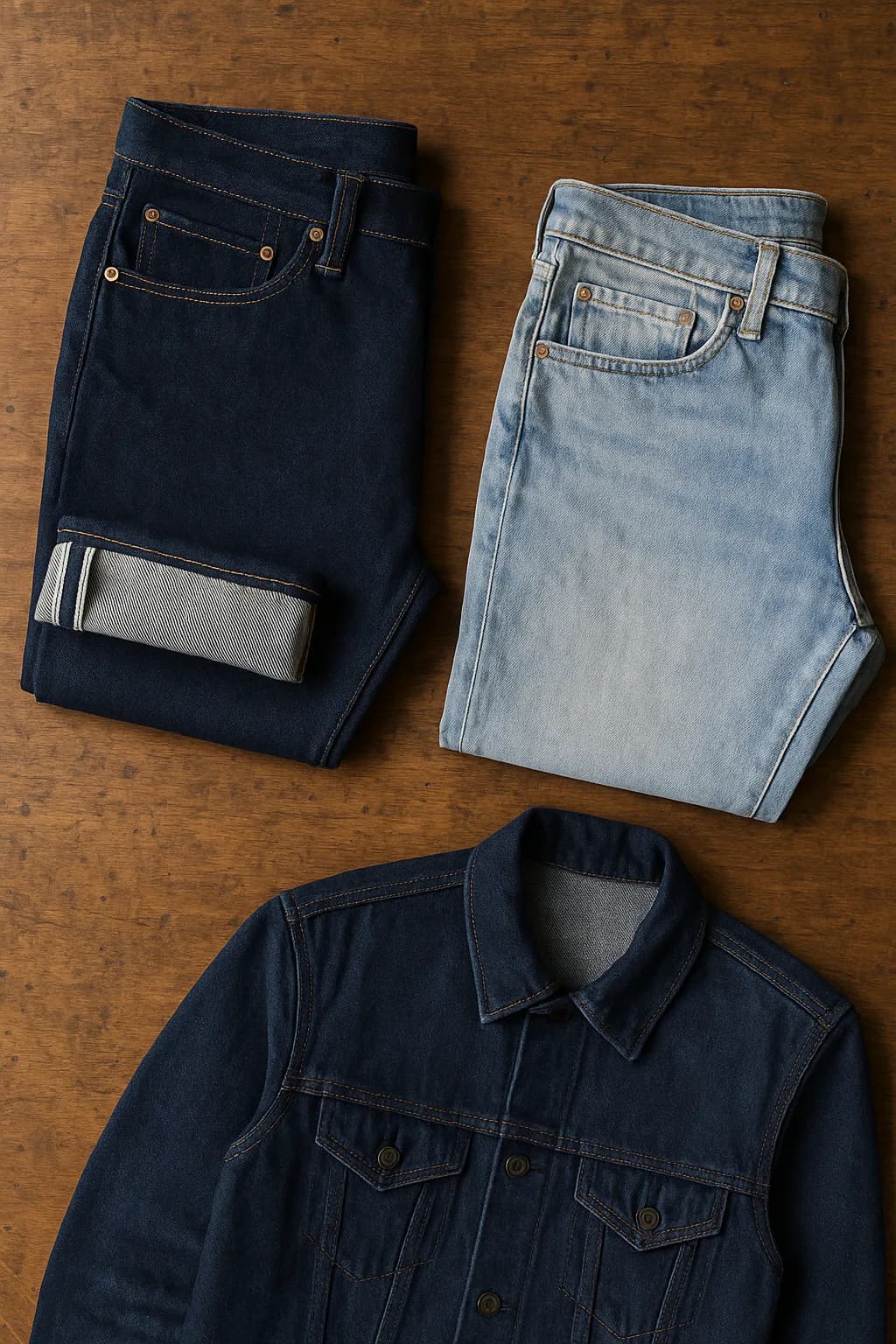
Denim
The work trouser that became everything else.
Jeans worn with a sport coat or tucked-in shirt want a fuller cut and higher rise than low-slung casual pairs. A low rise sits awkwardly under tailoring.
Repair jeans early: a small hole is easier to mend than a large one.
Read all 32 rulesClose the list
Straight, fuller-legged jeans sit best over heavy boots. Skinnier jeans pair better with a short, trim leather jacket.
The leg shape should balance the weight of the shoe or outer layer.
On an older man, slim jeans work only if the leg does not cling and the rise is not low. A slim-straight, slightly tapered leg suits more outfits.
Slim without clinging suits a wider range of builds.
Wash jeans in cold water with a gentle detergent and never tumble dry them. Regular washing keeps dirt from wearing the fibres.
Thick, rugged leather and heavy boots suit raw denim and rugged jackets, since durable, ageing materials match each other.
White jeans are easier to dress up than indigo, and a natural partner for a linen or light summer sport coat. Cream looks less preppy than pure white.
Black jeans add contrast under blue outerwear, so a washed blue chore coat or denim jacket avoids head-to-toe denim. Changing the shade of each layer does the same.
Gently flared legs sit comfortably over boots.
Jeans with a high rise and a comfortable straight leg suit men leaving very slim cuts behind while staying classic. A fuller leg also flatters a broader build.
Old jeans may have shrunk, so the waist size on the tag can be wrong. Always compare measurements.
When shopping for jeans, name what you dislike about your current pair, such as too full, too tapered or too low, to find a better fit.
Very slim jeans cut for a low rise suit only the very young and lean. A slightly higher rise keeps the slim leg without looking shapeless.
Low-slung slim jeans flatter few bodies.
Buying jeans a size or two small to allow for stretch leaves them tight and marked. Most decent jeans stretch only about an inch and a half.
Soaking jeans while wearing them in a bath pulls the knees and hips out of shape. Soak unsanforized denim off the body.
Tweed is the easiest jacket cloth to wear with jeans. A loosely set Shetland suits them especially well.
A tailored jacket meets denim halfway when it is soft-shouldered, sporty and textured, in heavy cotton, tweed or crumpled linen.
A sport coat worn with jeans is cut shorter and slimmer than a classic dress cut, or the mix looks mismatched.
To avoid head-to-toe denim, put contrast between jacket and trousers: a dark jacket with faded jeans, or tan, olive or black trousers.
Vintage denim jackets are worth measuring before buying, since hot washing may have shrunk them.
Denim with an irregular weave fades unevenly. Raised parts wear light and recessed parts stay dark, giving blue flecks up close and a faded look from afar.
Darning hides a repair better than a patch, and a backing stops it tearing out. It stiffens cloth and cannot save worn cuffs, which are better cut off.
Felled seams and single-needle stitching leave the inside of jeans as tidy as good trousers. A one-piece fly looks cleaner than a two-piece one.
On denim the blue lengthwise yarns wear through first. Where only pale cross threads hold an area together, it is about to tear, so mend it then.
Stress points include pockets, hems, crotch, knees and buttonholes.
Natural wear, repairs and fraying on secondhand denim give better fade patterns than pre-distressed new pieces.
Look for a dropped shoulder seam and a V-shaped upper body in a classic denim jacket. Better vintage ones have higher armholes and slimmer bodies.
Unsanforized denim fades with uneven, textured streaks, while most denim fades smoother and flatter. Cloth that is not pre-shrunk keeps more grain as it wears.
Sanforizing removes shrinkage but flattens the fibres, so cloth turns smoother and more even. Unsanforized denim shrinks: buy a size up and soak it first.
Raw denim moves with wear, shrinking and stretching, so a pair made to measure from raw cloth will not hold its shape.
A rinse before sale removes weave-stiffening starch, making jeans lighter, softer and quicker to break in.
The starch is added in the finishing step that controls shrinking.
Black denim with a dark weft fades visibly to grey; a white weft fades less. Sulfur dye fades more than reactive dye, which lasts deeper.
The dyes bond differently with the fibre.
A cropped denim jacket with a wide cut and dropped seams looks more relaxed than a trim, tapered one.