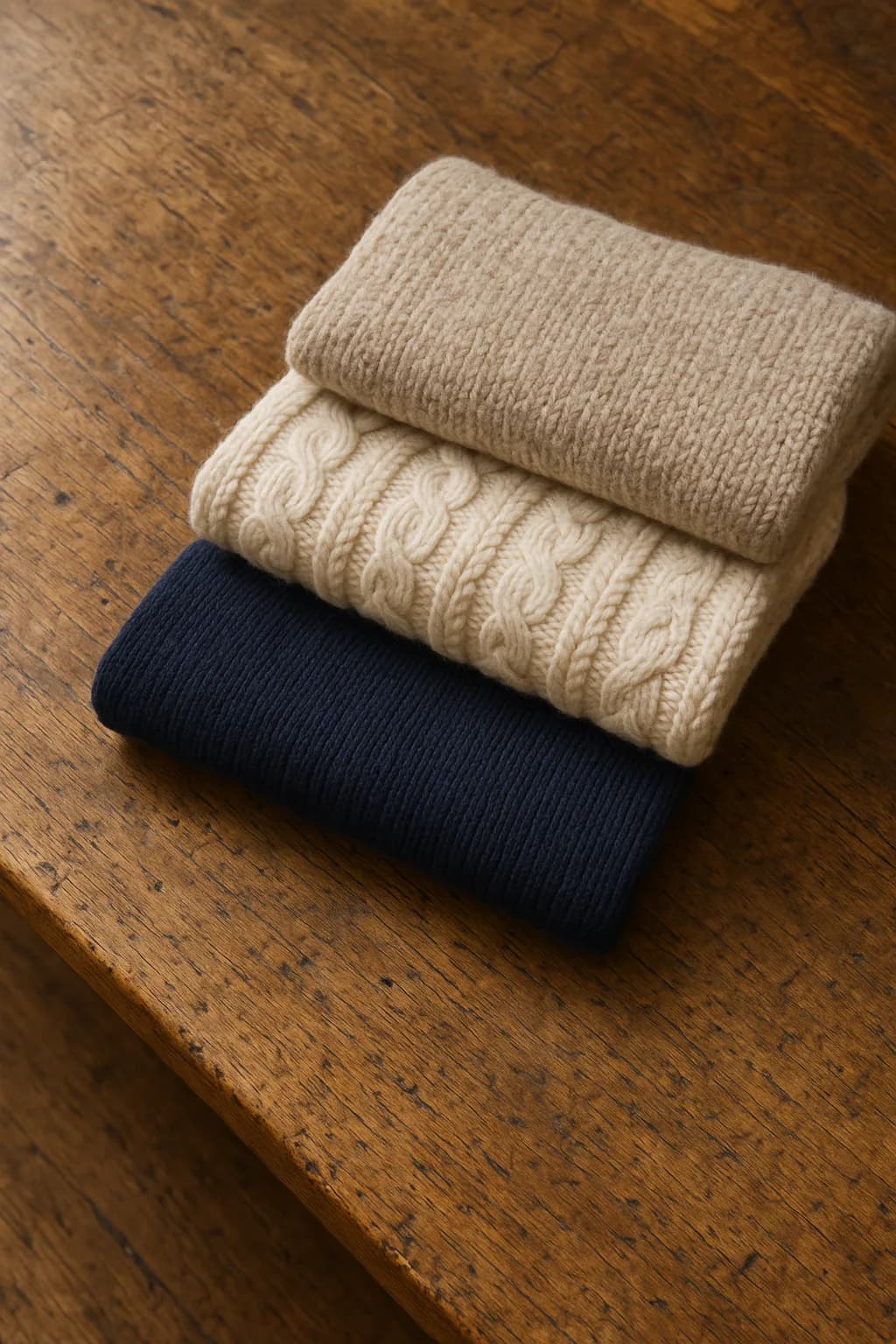
Knitwear
Yarn, ply and gauge, and where each one belongs.
A thin sweater of one or two plies fits under a jacket. A thick four-ply knit belongs in the outer layer.
Bulk limits what can sit beneath tailoring.
A navy sweater with blue jeans can look off unless the jeans are light enough to give contrast.
Close dark tones merge.
Read all 71 rulesClose the list
Plain outerwear gains interest from heavy textured knitwear underneath. Keep a scarf solid but textured so nothing stands out alone.
Texture replaces pattern.
Lambswool and Shetland generally wear harder than basic merino and often show more depth of texture and colour, which helps worn without a jacket.
Rub cashmere between the fingers. An oily residue on the skin suggests a softening treatment and a poor quality knit.
A knit that is too large can be slimmed, and one with side seams can be taken in at the body, but a small one cannot be enlarged.
When unsure, take the larger size.
A v-neck worn without a tie wants a button-down collar, or the collar splays over the sweater.
A thin wool base layer under a shirt and sweater adds warmth without bulk.
Cashmere shows its quality only with wear, as bagging and pilling appear over months. Be wary of verdicts written on a brand-new sweater.
One good cashmere sweater in a useful colour, such as mid grey, navy or tan, does more than several cheap ones in novelty shades.
Linen knitwear is cool in warm weather and warm in cool weather, so it suits mild spring and late autumn days.
Linen sits between formal city cloth and casual country cloth.
A cardigan under a jacket can do the work of a tie. It relaxes the look and breaks the line between jacket and shirt.
A smooth fine-gauge sweater looks best under a sport coat, where the jacket shapes the figure and the neckline adds a V.
Chunky textured knits suit wearing alone, or beneath a loose casual jacket. A close-fitting tailored jacket has no room for them.
A sweater hem stops at the hips. Pulled down further, it reads as womenswear.
Shetland and lambswool are rougher than cashmere, so wear a shirt beneath them rather than bare skin.
A knit in a shade near the jacket's main colour gives a tonal outfit and dresses down tailoring without the tie decision.
Varying the shade inside one colour family keeps it tonal.
Ochre is a safe first step beyond neutrals, and a knit is the easiest way to add it.
It suits autumn and still reads cheerful in spring.
A slim sport coat calls for a thin one- or two-ply turtleneck with fitted shoulders. A roomier jacket can take chunky or thin knits.
Navy is the easiest turtleneck colour. Grey, burgundy and green also sit well with autumn-toned jackets.
A turtleneck suits jackets and coats with a distinctive collar, and rugged outdoor pieces.
Roll a turtleneck high and let only a hint of shirt collar show. Collar points that pop out break the line.
A thin turtleneck sits between a tie and a crew neck in formality, which suits casual suits.
A thin charcoal turtleneck layers well under a tailored jacket. It stops just short of black, so it looks soft rather than severe.
A knit that sits over a creased shirt hides the creases and leaves only the collar to show.
Wool gives a knitted cap warmth and a richness of surface that acrylic lacks.
With a crew neck sweater and a collared shirt, let the sweater neckline hold the shirt collar up. A button-down collar helps.
Fully fashioned knitwear is shaped on the machine and linked stitch to stitch, not cut from cloth and sewn. It marks a better sweater.
It is slower work, usually kept for better garments.
Cheap cashmere is loosely knitted from short fibres, so it pills and loses its shape within a season.
Linen has no natural crimp, so many linen knits hang limp. A good one feels dry and springs back, and its cuffs hold.
A hand-knit sweater is more textured and dense than a machine knit, which is flatter. Machine-knit quality depends on yarn, density and finishing.
Machine knits range from cheap to excellent.
A hand-knit cardigan is knitted at a lower gauge than a machine-knit one, so it is chunkier and heavier and can pass for a light coat.
A sleeve that is too long on a knit pullover is a cheap job for a tailor to shorten.
A henley with a narrow neck opening and a slim placket looks refined. A wide, heavy one looks rugged.
A tightly knitted ribbed hem keeps a sweater from riding up the torso.
A cheap sweatshirt loses its shape at the ribbed hem, so it hangs rather than sits taut. A wash and dry can restore it.
A reverse-weave sweatshirt has its ribbing running across the body, which is said to limit shrinking in the wash.
A zip closure pulls a cardigan collar back further than buttons do, because the zip drags on it.
A well-made sweater is soft yet barely pills, and is knitted densely enough to keep its shape for years with care.
A cotton knit stretches more easily than wool. With a stretchy stitch, expect a slightly slouchy result.
A fisherman's rib looks the same on both faces. A Shaker stitch differs slightly between the front and the back.
A seamless sweater in tightly knitted, hard-twisted worsted yarn sheds rain and resists wear at the sides.
A tightly twisted yarn in a dense knit repels water, though it is scratchy and best worn over another layer.
A boxy body and dropped shoulder seams identify a fisherman's gansey.
A warm ivory knit sits gently beside a warm grey jacket. Optic white would jump out harder.
A hoodie hood that sits neatly on the shoulders frames the face. A larger, slouchy hood drapes across the back and loses that effect.
Rugged outerwear and knits depend on weight and fine detail that photographs miss. Judge them by handling and trying them on.
Simple designs in good cloth photograph poorly.
A sweater under a jacket gives a more finished look when the jacket comes off, which suits a cool office.
Tie and v-neck sweater without a jacket can look as if the jacket was left behind.
Four-ply cashmere wears better than two-ply and still goes under a jacket, provided the jacket is not cut too slim.
A very soft new cashmere sweater may have lost durability in finishing. A dense knit from long fibres pills less and softens with wear.
Heavy finishing makes cashmere fluffy but weakens the yarn.
Pure cashmere has little spring, unlike wool, so it suits scarves and knits better than tailored pieces that need to recover their shape.
Wool's natural crimp helps cloth drape and keeps knees from bagging.
A plain v-neck sweater works under a jacket but looks bland alone. A textured knit, such as lambswool, cable or fleck, is more versatile.
A textured sweater is easier to wear than a loudly patterned one. It gives a plain jacket interest and calms a busy one.
Texture is quieter than pattern.
Heavily flecked knitwear can dominate. It sits well beneath a waxed cotton jacket or a loden overcoat.
Heathered grey is the easiest sweatshirt colour. Stone, olive, muted blue and soft charcoal follow.
A half-cardigan stitch has more body and stretches less than a ribbed Shaker or fisherman's stitch.
Tightly spun worsted yarn pills less than woollen yarn, but it lacks the fuzzy depth of texture.
A heavy, thick-yarned sweater is cut to fit snug at first, then softens and stretches over a few wears, much like raw denim.
A bulky shawl-collar cardigan can stand in for a jacket over a shirt and flannel trousers. It also layers over a fine merino rollneck.
A shawl-collar cardigan frames the face like a jacket. For going out, a heavier, more rugged knit works better than a soft one.
A smooth sweater over a collared shirt frames the face and suggests mild formality. It is safe rather than interesting.
Black knitwear suits contemporary wardrobes and gives a neutral ground for outerwear in olive, tan or stone grey.
A brighter colour in a staple knit, such as green or pink in a Shetland, lifts a navy, brown and grey wardrobe.
A turtleneck throws the face into relief. Under a suit it takes the place of a tie, so the suit reads less formal.
A thick turtleneck runs hot indoors, so a thinner knit is more practical in heated rooms.
A looser, non-clingy knit looks at ease. A trimmer, thinner one looks disciplined.
A thin turtleneck stands in for a tie, since it fills the chest that an open collar leaves bare.
A chunky cream turtleneck makes a good base under heavier outerwear, as a charcoal one does.
A fine-gauge knit goes well with shorts. Thin cotton or linen knits forgive heat better than cashmere.
A soft knit under tailoring spares the ironing of a shirt and fills the gap between jacket fronts when no tie is worn.